Blossoming Orchards, Starry Nights Vincent van Gogh
Arles
The light and colour of the country surrounding Arles radically transformed Vincent van Gogh’s art and for eighteen months he produced works of genius.
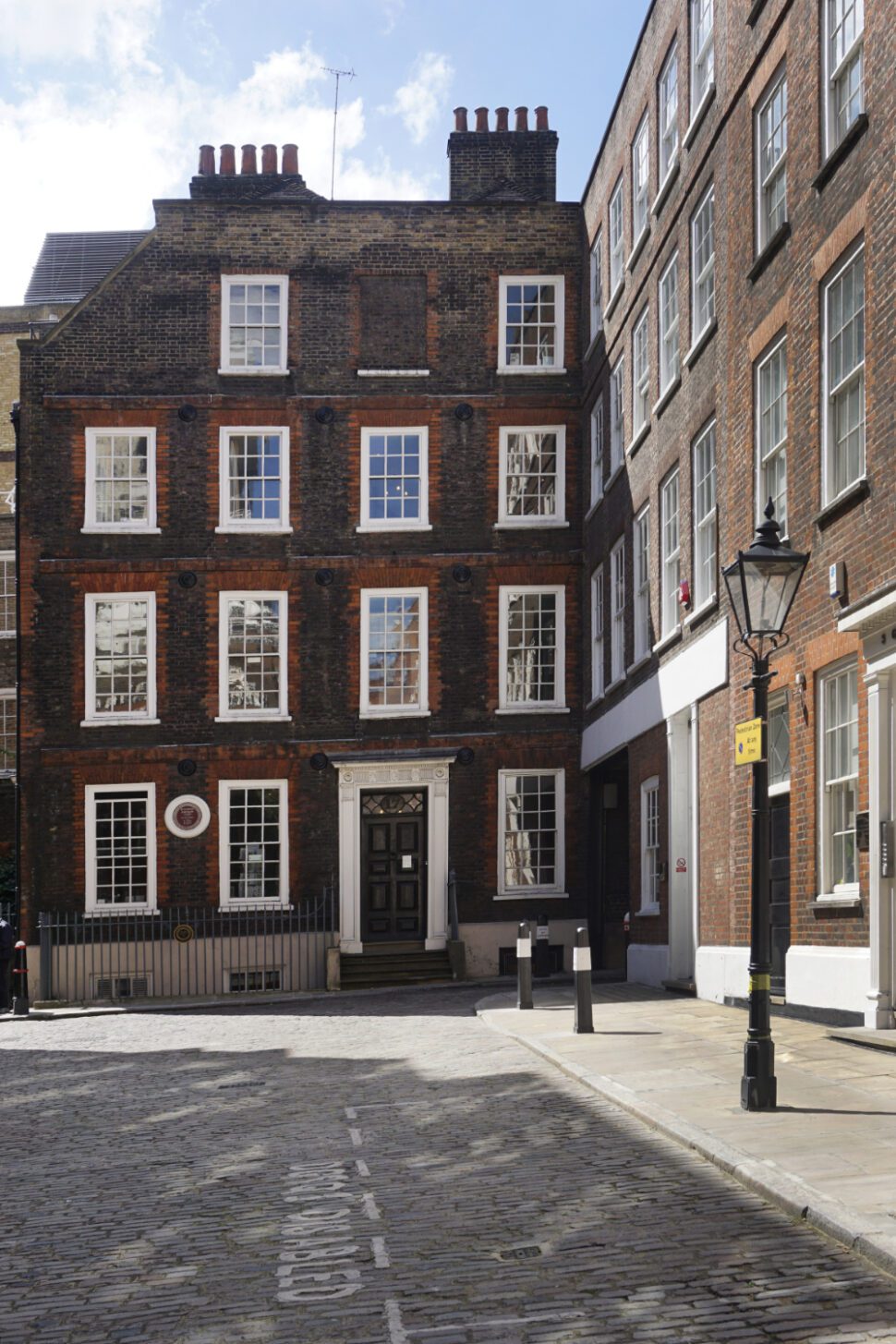
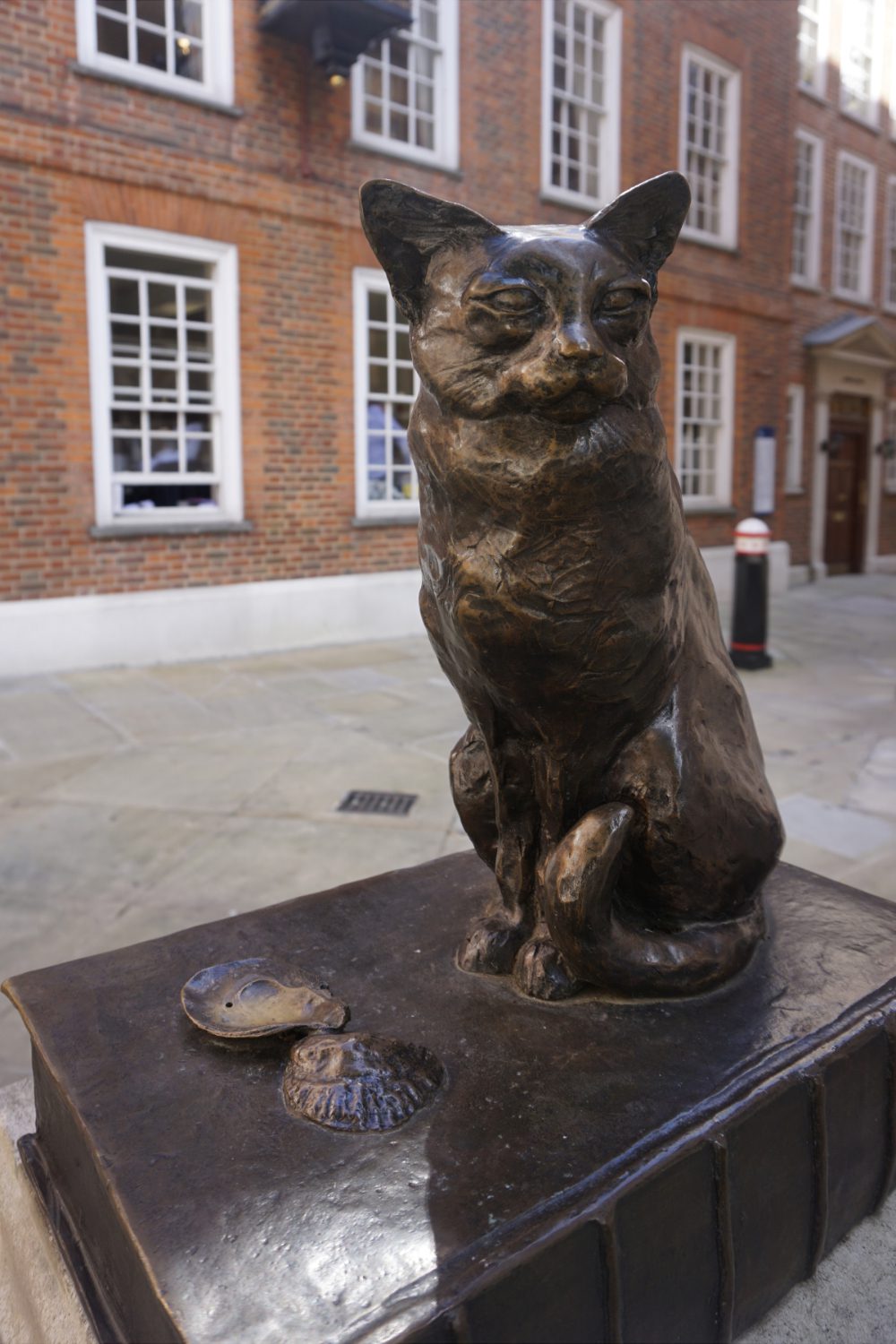
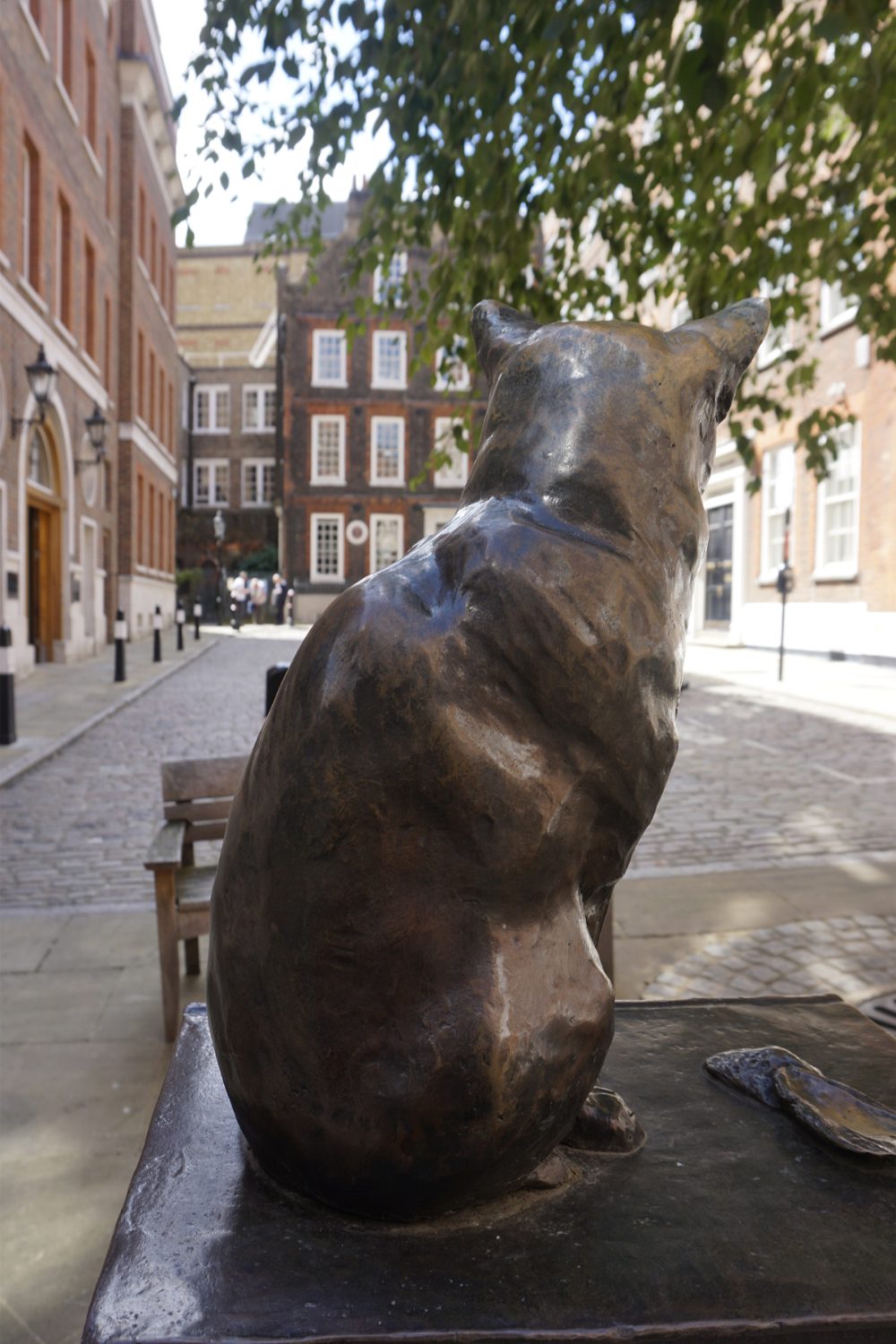
Samuel Johnson, lexicographer, literary genius and lover of London, treated his cats with uncommon tenderness. A statue of his most celebrated cat stands in front of his house at 17 Gough Square. Hodge was a large black cat for whom Johnson regularly bought oysters at Houndsditch market. James Boswell has this to say about Hodge in The Life of Samuel Johnson:
I never shall forget the indulgence with which he treated Hodge, his cat... I recollect him one day scrambling up Dr. Johnson's breast, apparently with much satisfaction, while my friend smiling and half-whistling, rubbed down his back, and pulled him by the tail; and when I observed he was a fine cat, saying, 'Why yes, Sir, but I have had cats whom I liked better than this;' and then as if perceiving Hodge to be out of countenance, adding, 'but he is a very fine cat, a very fine cat indeed.’
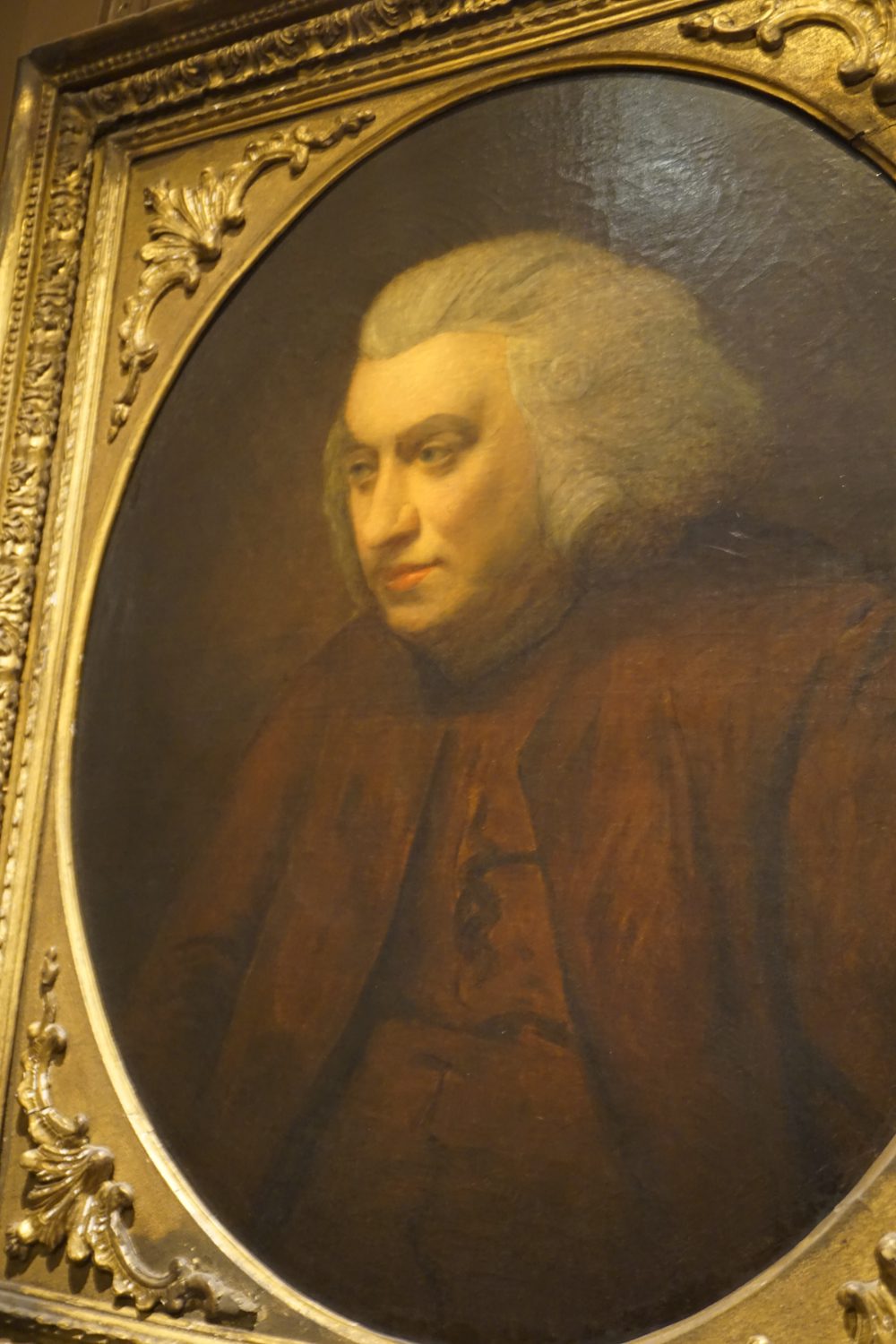
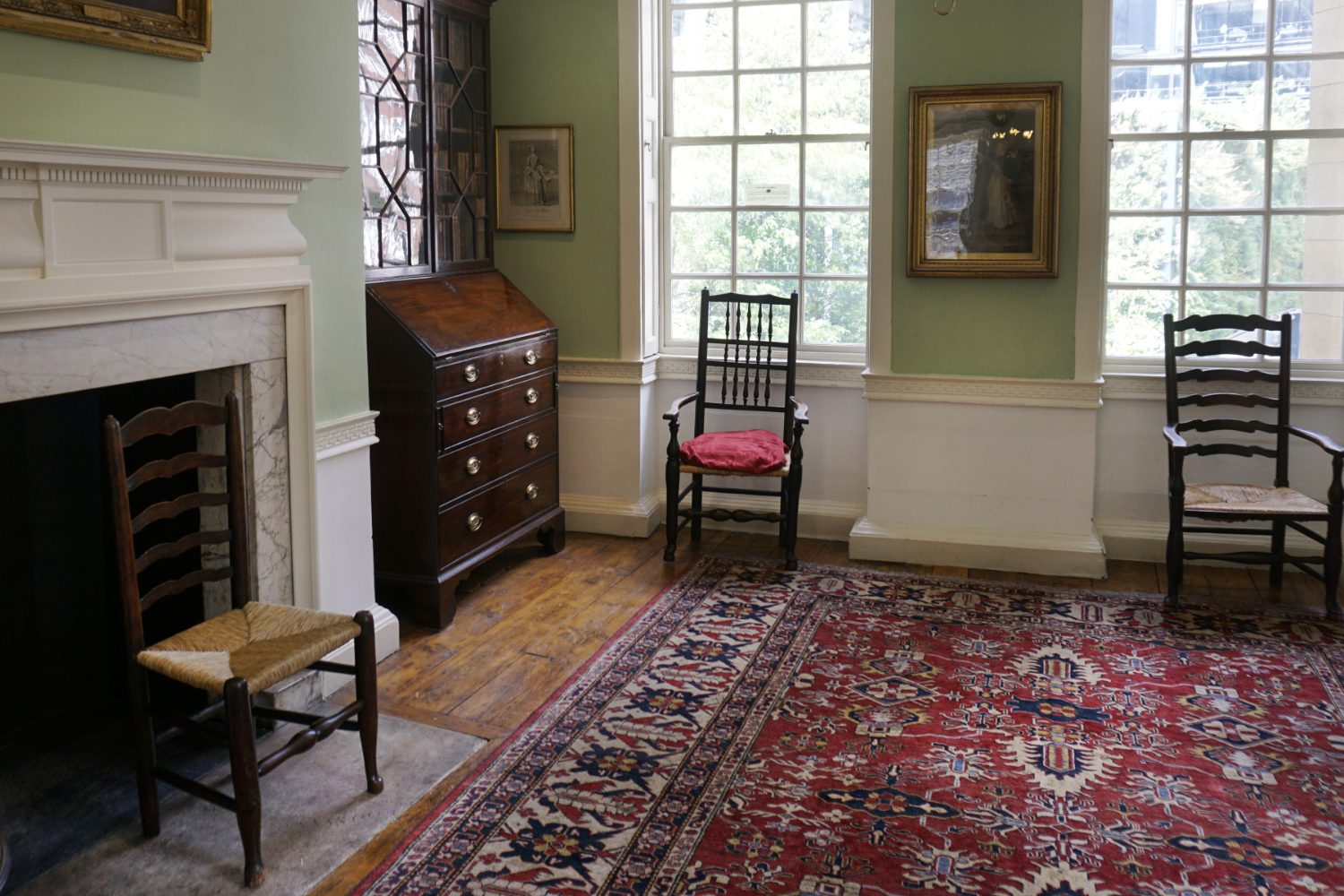
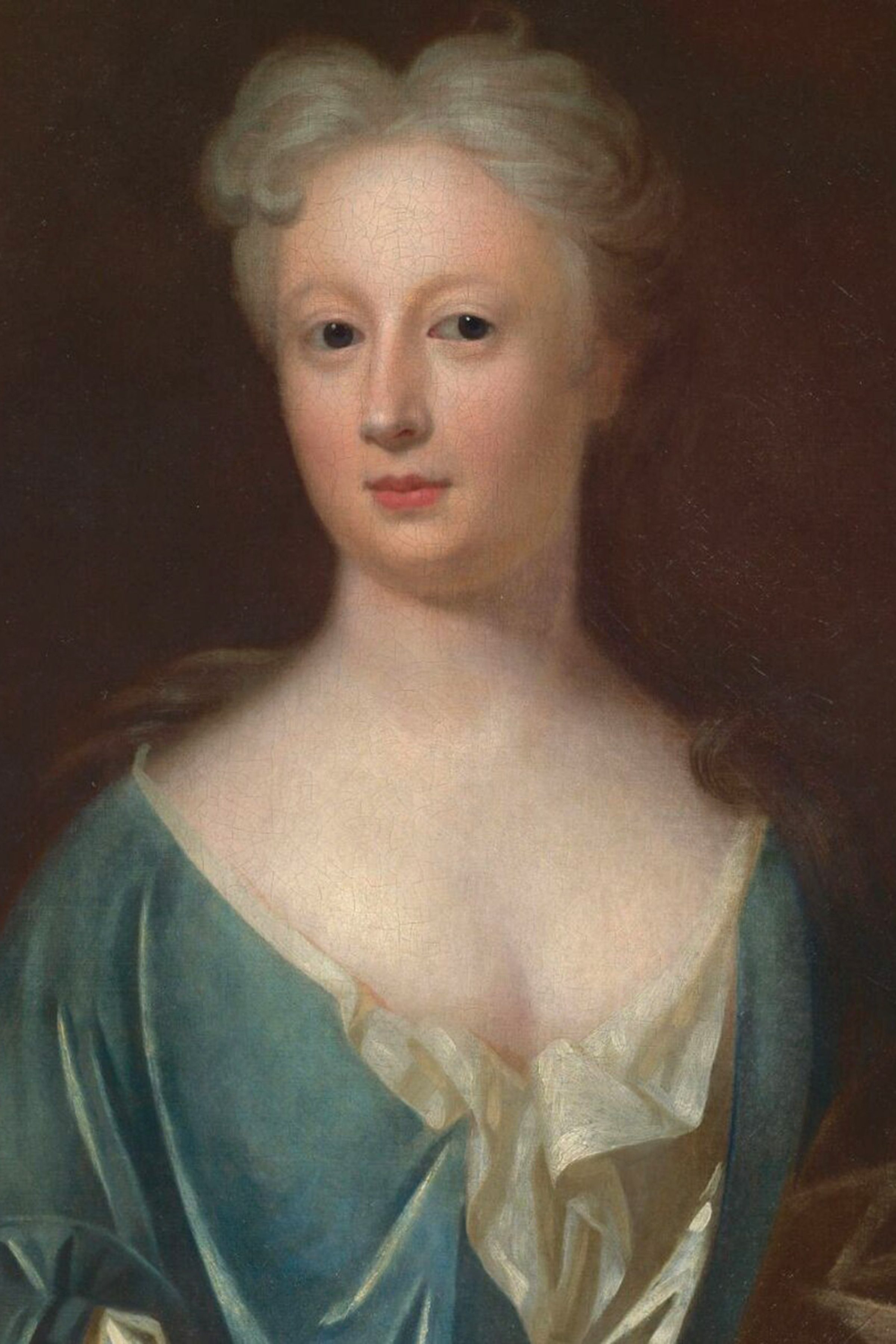
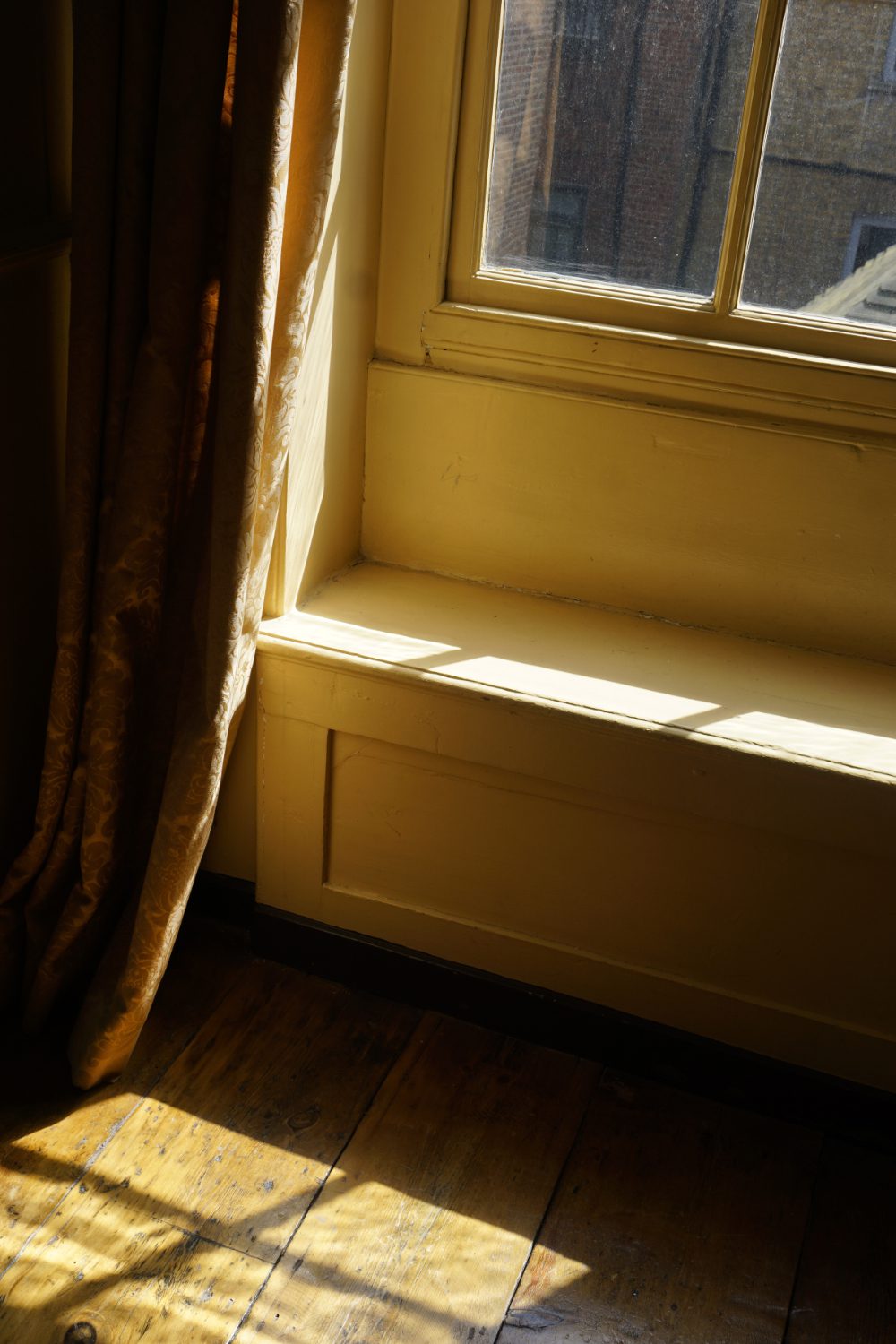
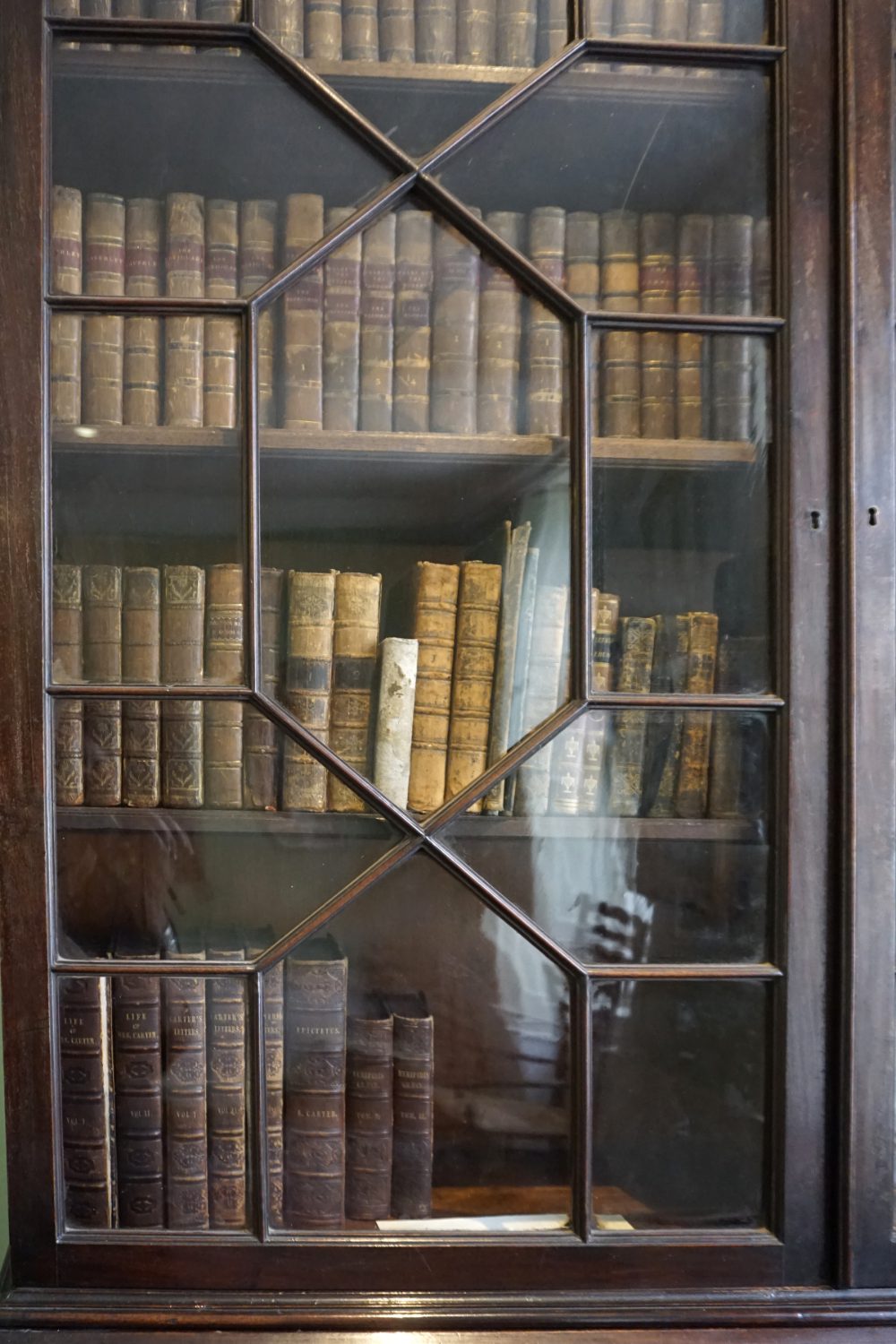
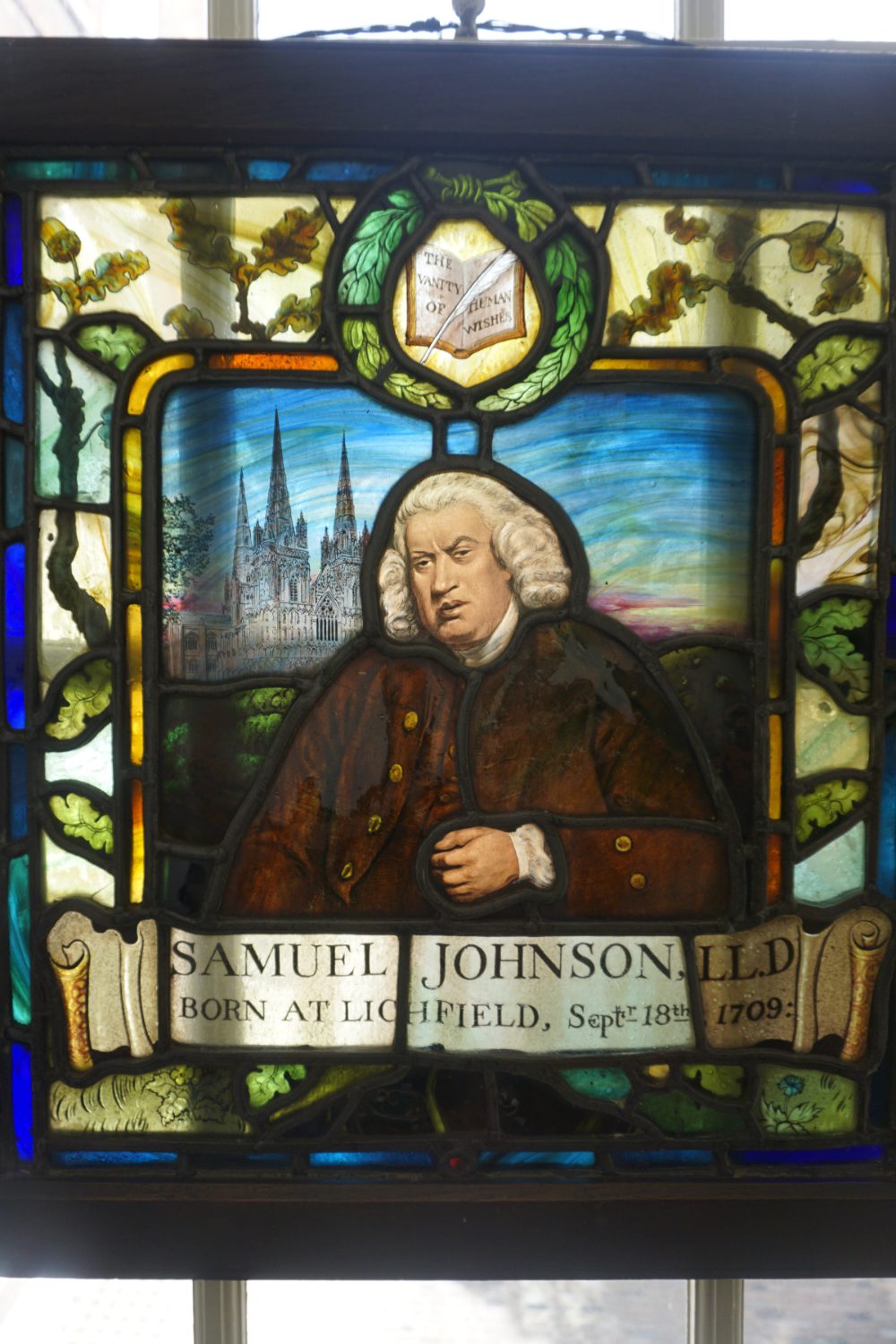


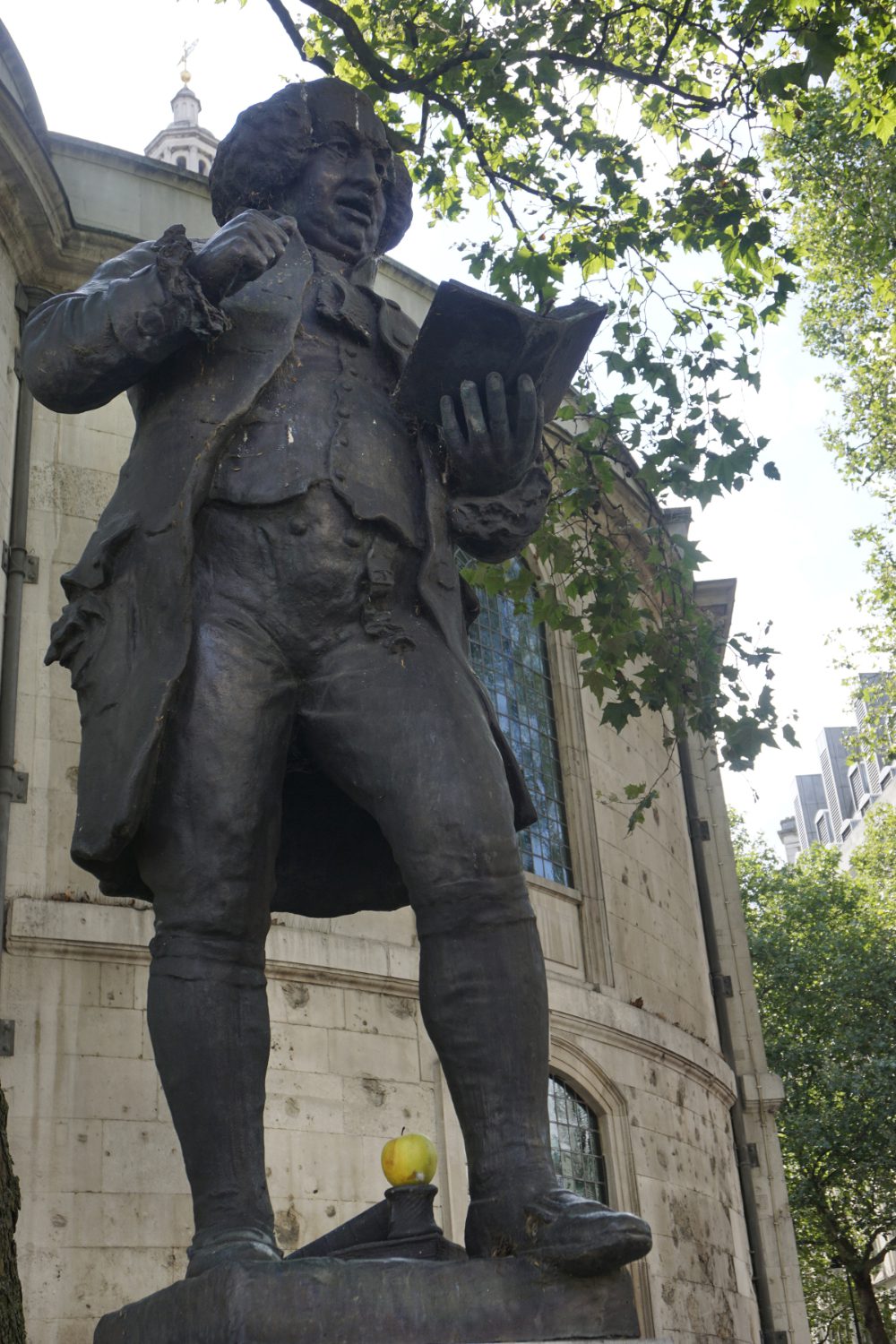
Against all odds, Samuel Johnson, a poor boy from provincial England who was beset by involuntary tics and melancholia, became a literary giant of 18th century London. He dominated intellectual life as an essayist, critic, poet and lexicographer and was affectionately dubbed ‘Dictionary Johnson’ by the populace. King George III gave him the use of his library at St James’s Palace and would ask to be told of his arrival so that he could seek him out for a chat. Like Oscar Wilde, Johnson was never lost for words when it came to making up epigrams and aphorisms on the spot. The urge to record these for posterity, particularly by James Boswell who wrote his great biography, has meant that Samuel Johnson is one of the prominent figures in history we feel we ‘know’ as a person.
The son of a bookseller from Lichfield in Staffordshire, Johnson had been precociously bright, composing poetry at three, translating from the classics at six. He had the run of his father’s bookshop, and his biographer James Boswell much later observed his ‘ravenous’ way with books, tearing into them like ‘a dog who holds a bone in his paws in reserve, while he eats something else which has been thrown to him.’
An unexpected legacy enabled Johnson to attend Oxford. At this crucial period of his life he read a devotional work by William Law, A Serious Call to a Devout and Holy Life (1729), that became profoundly influential. He later told Boswell that prior to reading the book he had been ‘a sort of lax talker against religion’. But Johnson was persuaded by Law’s argument that human desires, ambitions and possessions are ultimately empty: only religion can satisfy the heart and provide stability and purpose in life. These beliefs, to which he added his own humour and charity, were to underpin all his moral writings. As he was to later say: ‘The true measure of a man is how he treats someone who can do him absolutely no good.’
While at university Johnson tried to survive on a pitiful amount of money. His debts mounted, his clothes became threadbare and he stopped attending lectures when his toes began to poke out of his shoes. A benefactor left a new pair of shoes by his door but ‘bursting with indignation’ and mortified by shame, Johnson threw them away. After a year his money ran out and despite having been ‘loved by all about him’, and told by one master that he was the best scholar he had ever known, he was forced to leave the university without a degree.
After this, Johnson suffered a complete psychological breakdown. He was overwhelmed with guilt, anxiety, and a ‘dejection, gloom, and despair, which made existence misery.’ This wretched condition lasted five years and there were times when he said he came close to insanity.
Afterwards, Johnson later told a friend that the ‘great business of his life was to escape from himself; this great disposition he considered as the disease of his mind.’ His main mental weapon against this melancholy, with its accompanying guilt and self-loathing, was his own industry (as it was for Cézanne and van Gogh). In his early life and well into middle age, he worked relentlessly. His breakdown had taught him never again to be caught unaware by hopes and dreams; to be forewarned was to be forearmed, and so it was necessary to stick to reality. As his biographer Jackson Bate observes, it is no small irony that Johnson, who was to become the ‘supreme exponent and symbol of practical common sense, of unremitting grip on concrete reality, should have begun his adult life in fear for his sanity’.
When he was twenty-five and just emerging from his depression, Johnson married Elizabeth, the widow of his friend Harry Porter. Tetty, as she became known, was a mother of three, the daughter of a squire and in possession of a sizeable dowry. She was also twenty-one years older than her poverty stricken suitor, who seemed hardly much of a catch. A bout of scrofula (a tuberculosis infection) in childhood had impaired Johnson’s hearing, and left him partly blind in one eye, and he bore its deep scars on his face and body. He also suffered from a variety of tics, twitching, gesticulations and involuntary vocalisations (blowing like a whale, making clucks and wheezes and prone to blurting out the prefix ‘Sir!’) that has been retrospectively diagnosed as Tourette’s syndrome. But despite these conditions, Johnson’s ‘forbidding’ appearance, and ‘his immense structure of bones’ that were ‘hideously striking to the eye’, Tetty was so taken by his conversation that she told her daughter Lucy: ‘This is the most sensible man that I ever saw in my life.’ At the time the word ‘sensible’ did not just mean rational or sober; it could also be taken to mean ‘eager’, ‘quick’ and ‘perceptive’.
The main obstacle to their union was the strong opposition of her two sons and family. One family member had offered Tetty a small fortune if she refused Johnson’s proposal of marriage and her oldest son who was training to become a naval officer, was so appalled at the grotesqueness of her suitor that he threatened to never see his mother again.
Johnson was only too aware of the impact of his afflictions on others. He later told a friend that he had never tried to make a good impression on anyone until after the age of thirty, ‘considering the matter as hopeless.’ But Tetty would not be dissuaded and they were married in Derby on 9 July, 1735.
Ironically, some thirty years later, once Johnson had become famous, it was Tetty who ended up at the poor end of the equation, with people puzzled as to what he could have seen in her. But most of Johnson’s later friends had not witnessed the couple’s early relationship. Tetty’s last years were not her best. As she aged and her prettiness faded, she lost confidence. She tried to play the coquette and created, according to one of Johnson’s friends, ‘swelled cheeks, of a florid red, produced by thick painting, and increased by the liberal use of cordials’, so that she unjustly became a comic character amongst Johnson’s milieu. Yet Johnson steadfastly maintained: ‘It was a love match on both sides’. Early in their relationship she had been ‘so shrewd’ and cultivated that Johnson had included her in all his literary endeavours. They read plays together and he said that nobody could read comedy better than she. Johnson remained loyal to Tetty, ever grateful for the way she had brushed aside his afflictions, giving him help and confidence when he had felt like a complete nobody.
Before coming to London Johnson had attempted to establish a school near his birthplace of Lichfield but it had failed after only a few months. According to Boswell:
His oddities of manner, and uncouth gesticulation, could not but be the subject of merriment to [his pupils].
The venture had used up much of Tetty’s dowry. At age 27, about to chance his luck in the big city, Johnson was a poor, ungainly scholar, without any degree or useful alliances.Tall, bony, scarred and twitching, he was barked at by dogs, and mocked by schoolchildren. He left Tetty behind with family in Lichfield and arrived with a manuscript of his first play Mahomet and Irene which he hoped would make his name (it did not). But he had come with a friend: David Garrick, a former pupil from his school. The two found lodgings in one of the cheapest quarters in town, and from the minute he arrived, Johnson fell wildly in love with London.
Around the time of Johnson’s arrival in 1737, London was described by Daniel Defoe as a ‘great and monstrous Thing’, a capital of freaks, executions and masquerades. King Charles II had incentivised the rebuilding of London after the Great Fire of 1666, attracting skilled artisans from all over the world (including the woodcarver laureate Grinling Gibbons), and a great new metropolis had risen, much of it built in soft pink brick. It was a place of extremes with the destitute living in squalid, disease-ridden slums on one hand, and the privileged in their swanky mansions on the other. There was also a new social class headed by preening financiers, intent on revelling in money and pleasure.
London had become an increasingly diverse city. Among its many communities were: the Huguenots, Protestant refugees fleeing persecution from the Catholic monarchy in France; a large Scots population attracted to the city after their country’s successful union with England; merchants and courtiers from the east, and people who had been trafficked as part of the British slave trade in Africa (some were still enslaved, while others were free). Seven hundred thousand people were crammed into a bustling five mile area from Hyde Park in the west, to Limehouse in the east, with Charing Cross at its centre.
Johnson welcomed the city’s diversity, famously saying: ’When a man is tired of London, he is tired of life’. He came to believe that all its nooks and crannies deserved a thorough inspection, that they contained the ‘full tide of human existence’, as he told Boswell:
Sir, if you wish to have a just notion of the magnitude of this city, you must not be satisfied with seeing its great streets and squares, but must survey the innumerable little lanes and courts. It is not in the showy evolutions of buildings, but in the multiplicity of human habitations which are crowded together, that the wonderful immensity of London consists.
Shortly after arrival, Johnson met the feckless and debonair writer Richard Savage, who claimed to be the bastard son of a great family. Forever on the scrounge for patrons, he would squander in the taverns what little money he came by. After Savage’s premature death in 1743, Johnson wrote his biography, recounting his friend’s life with great compassion and sometimes humour, noting:
It was his peculiar happiness, that he scarcely ever found a stranger, whom he did not leave a friend; but it must likewise be added, that he had not often a friend long, without obliging him to become a stranger.
Soon after meeting, the two of them, well furnished with drink, began taking rebellious night time walks through London’s squares and alleyways, loudly discussing politics and boasting of their patriotism. According to Johnson’s first biographer, John Hawkins:
…they had both felt the pangs of poverty and the want of patronage…they seemed both to agree in the vulgar opinion, that the world is divided into two classes, of men of merit without riches, and men of wealth without merit…Johnson has told me, that whole nights have been spent by him and Savage in conversations of this kind, not under the hospitable roof of a tavern, where warmth might have invigorated their spirits, and wine dispelled their care; but in a perambulation round the squares of Westminster, St James’s in particular, when all the money they could both raise was less than sufficient to purchase for them the shelter and sordid cohorts of a night cellar.
Johnson was to provide the dictionary definition ‘noctivigation’ to describe such midnight rambles. Long after Savage died he continued this habit of ambling around in the wee hours, an activity that distracted him from self-absorption and self-hatred. He might begin his wander through the courts and alleys off Fleet Street, through the Strand, then move further out into the city’s seamy, sewage ridden alleyways (always armed with his trusty club), just as Honoré de Balzac was to wander the equally putrid streets of Paris at night some eighty years later, involved in an activity he called ‘optical gastronomy’.
In the autumn of 1769 Samuel Johnson sauntered around Poets Corner of Westminster Abbey with his friend the poet, novelist and playwright Oliver Goldsmith, gazing at the memorial stones to the great, and wondering whether their names would be included among them (they would be, along with David Garrick’s). Afterwards they headed for Temple Bar, the ceremonial entrance to London. Here the heads of traitors were displayed, impaled on iron spikes. They had become a city attraction and curious onlookers could hire spy glasses for a halfpenny to take a closer look at each new addition. Taking in this scene, Goldsmith slyly whispered in Johnson’s ear: ‘Perhaps our names will be mingled with these instead.’
London had become the sex capital of Europe. Visitors were amazed by ‘the vast number of harlots’ roaming its streets, especially around the Strand, Covent Garden and the lanes that crossed them. Coffee houses often doubled as brothels: the giveaway would be the sign by the door illustrating a woman’s arm holding a coffee pot. In public houses, ‘posture dancers’ performed an eighteenth century version of the striptease.
James Boswell was an enthusiastic customer of the ‘free hearted ladies’. In his journal he described one encounter on ‘the noble edifice’ of Westminster Bridge that had caused yet another episode of ‘signor gonorrhoea’. After they met, Johnson had tried (unsuccessfully) to persuade Boswell that ‘promiscuous concubinage is wrong’:
As we [Boswell and Johnson] walk’d along the strand tonight, arm in arm, a Woman of the town came enticingly near us. “No” (said Mr Johnson) “No, my Girl, it won’t do.” We then talked of the unhappy situation of these wretches, and how much more misery than happiness, upon the whole, is produced by irregular love.
On one of these night time excursions Johnson found a woman, a prostitute called Poll, lying sick and exhausted in the street. Taking pity on her he picked her up, carried her home on his back and nursed her back to health.
In Johnson’s early years he became an impoverished Grub Street hack, contributing reviews, essays and biographies to the Gentleman’s Magazine, a monthly digest of urban papers for country readers. Journalism was still in its early days and had yet to acquire the prestige or opportunities it was to provide in the nineteenth and twentieth centuries. It was tough, unrelenting work but over time Johnson became known for his epitaphs, his translations of the Odes of Horace, his fine biography of Richard Savage, and his epic poem ‘The Vanity of Human Wishes’.
Within a year Tetty joined her husband in London. Now in her late forties, it was a shock for her to leave a country town where she had enjoyed social standing, and become a nobody, living in cramped and inferior lodgings. London felt vast and unfriendly and her husband did not seem to be making much progress with his writing career. She railed against the mess he made, as Johnson (always slovenly) later confided to a friend:
She was extremely neat in her disposition & always fretful that I made the House so dirty – a clean floor is so comfortable she would say by way of twitting; till at last I told her, I thought we had had Talk enough about the Floor, we would now have a Touch at the Ceiling.
Before their first year together Johnson, feeling guilty about having spent so much of Tetty’s dowry, moved her to more expensive lodgings close to the open fields. It seems that he forwarded the bulk of his earnings to her, pretending he had more money than he actually had. During this time he was often wandering the streets with Richard Savage, sometimes without the means even to sleep in one of the crowded ‘night-cellars’ with ‘sordid cohorts’.
In this anonymous life of struggle and disappointment, it must have been galling for Johnson to witness the meteoric rise of his former pupil David Garrick. He had become London’s most famous actor due to his career defining role as Richard III. On the wave of renewed enthusiasm for Shakespeare’s plays in the 1740s, leading roles in Hamlet, King Lear and Macbeth quickly followed. Garrick was making a fortune and became a leading light of the Drury Lane Theatre. Of all the deadly sins, Johnson particularly disliked envy, yet in Garrick’s case it slipped out:
But what sort of ‘merit is to be allowed a man who simply claps a hump on his back, and a lump on his leg, and cries ‘I am Richard the Third?’ How is he more deserving than a rope-dancer, or a ballad singer?
Their relationship would often be tense and was not helped by Garrick, who began putting on airs as soon as he became successful. Johnson could never resist puncturing his ego with remarks about ‘entertainers’ who considered themselves authorities. Yet he never let anyone else put him down.
There was one consolation for Johnson during these years. While visiting his home town of Lichfield he had fallen in love with Molly Aston, the sister-in-law of a friend. Many years later he confessed to Hester Thrale (another woman he came to love) that he had experienced ‘measureless delight’ and ‘rapture’ during one evening in Molly’s company. Johnson described her as a ‘beauty and a scholar, and a wit and a whig’, ‘the loveliest creature that I ever saw’. She was just three years his senior, well read and a brilliant conversationalist, ready and willing to put others in their place. Many found her intimidating but Johnson had blossomed in her presence, and thoughts of her had ‘sweetened’ the rest of his year.
Molly was one of a number of female intellectuals with whom Johnson became infatuated, and whose work he often championed (among them the Classicist Elizabeth Carter). He supported women’s education and achievements in an age when such encouragement was unheard of. There is an account by his biographer Hawkins of Johnson organising a magnificent feast for twenty people at the Devil Tavern to celebrate the publication of young Charlotte Lennox’s first novel Harriet Stuart. He called the book her first ‘literary child’, asked for readings, ‘prepared for her a crown of laurel’, and invoked the Muses while ceremonially encircling her head. Then, drinking only lemonade, he indulged in conversation with this bright woman for the rest of the night. It was not until eight, with ‘the creaking of the street door’ which gave the ‘signal for our departure’ that the party emerged wearily into the morning light; all except for Johnson, who burst out the door in an exhilarated mood.
Johnson’s reputation as an unyielding conservative, a die hard Tory, is an oversimplification. His conservatism was never rigid or unfeeling but rather a ‘thoughtful advocacy of restraint and continuity’ allied with a desire to ensure a ‘co-operative endeavour’ of people. He abhorred all forms of tyranny or corruption, and while discussing the disadvantaged, lamented a world that had ‘forsaken mutual obligation’.
By his mid thirties, Johnson had become a brilliant, witty conversationalist who could also be brusque, rough and impatient. At the hint of insincerity, smugness or flimflam he was likely to fiercely admonish the person in the midst of a conversation and send them packing. He mocked hypocrites, those who abused their power, the chattering aristocracy or sensationalist newspaper reporting. And he had a talent for friendship. After his breakdown so early in life (the depression would never fully leave him), Johnson had become a sensitive and reassuring friend to those beset with fear or sorrow.
Johnson’s sense of responsibility to Tetty had fuelled a new life in the midst of London’s Grub Street. Despite his rarely rising until noon, his output for the next eight years was astonishing. For his famous Parliamentary Debates for instance, Johnson wrote nearly half a million words, for which he produced an average of eighteen hundred words an hour, or thirty words a minute.
In 1746 Johnson was invited by a group of booksellers, who had noted the quality, quantity and versatility of his writing, to create a new dictionary of the English language. There had been consternation amongst the intelligentsia over the lack of a major English dictionary. The language was in a state of flux and without a standardised dictionary there were inconsistencies in spelling, pronunciation and usage. Previous attempts had tended to be limited in scope, such as glossaries of obscure words, rather than definitions of everyday language.
To compile a thorough and reliable reference of English seemed an overwhelming task but Johnson recognised that by producing such a dictionary his reputation in the literary world would be assured. He would also finally be in a position to support Tetty in the manner to which she was accustomed. He signed a contract worth 1,500 guineas, a staggering sum at the time, and said he would complete it in three years. It was an arrogant claim: a French equivalent undertaken by forty scholars at the Académie Française had taken forty years to complete.
In need of larger premises to compile what would become A Dictionary of the English Language (1755), Johnson leased 17 Gough Square, off Fleet Street, set in a maze of narrow streets and walkways that open out onto small squares. It provided Johnson with ample space for living and working and he would stay here from 1748 to 1759, longer than anywhere else in London.
The new home was as large and handsome as the house in Birmingham where Johnson had first met Tetty. At last he could offer her a home that was at least comparable to the one she had given up for him. She had her own bedroom and sitting room on the second floor. Its four storeys were connected by a narrow central staircase and it became one of Johnson’s compulsions to tap the top of each balustrade with his fist as he went past. If he missed a balustrade, he would have to go back to the beginning and start again.
There is a thick, heavy chain on the front door which in Johnson’s time was used to deter creditors. His debts would keep him awake at night. He had vastly underestimated the time it would take for him to complete the dictionary (just over eight years instead of three) and was always short of money. Once, after racking up a large bill for milk, he barricaded the front door with his bed for fear of being carted off to the debtor’s prison in Southwark.
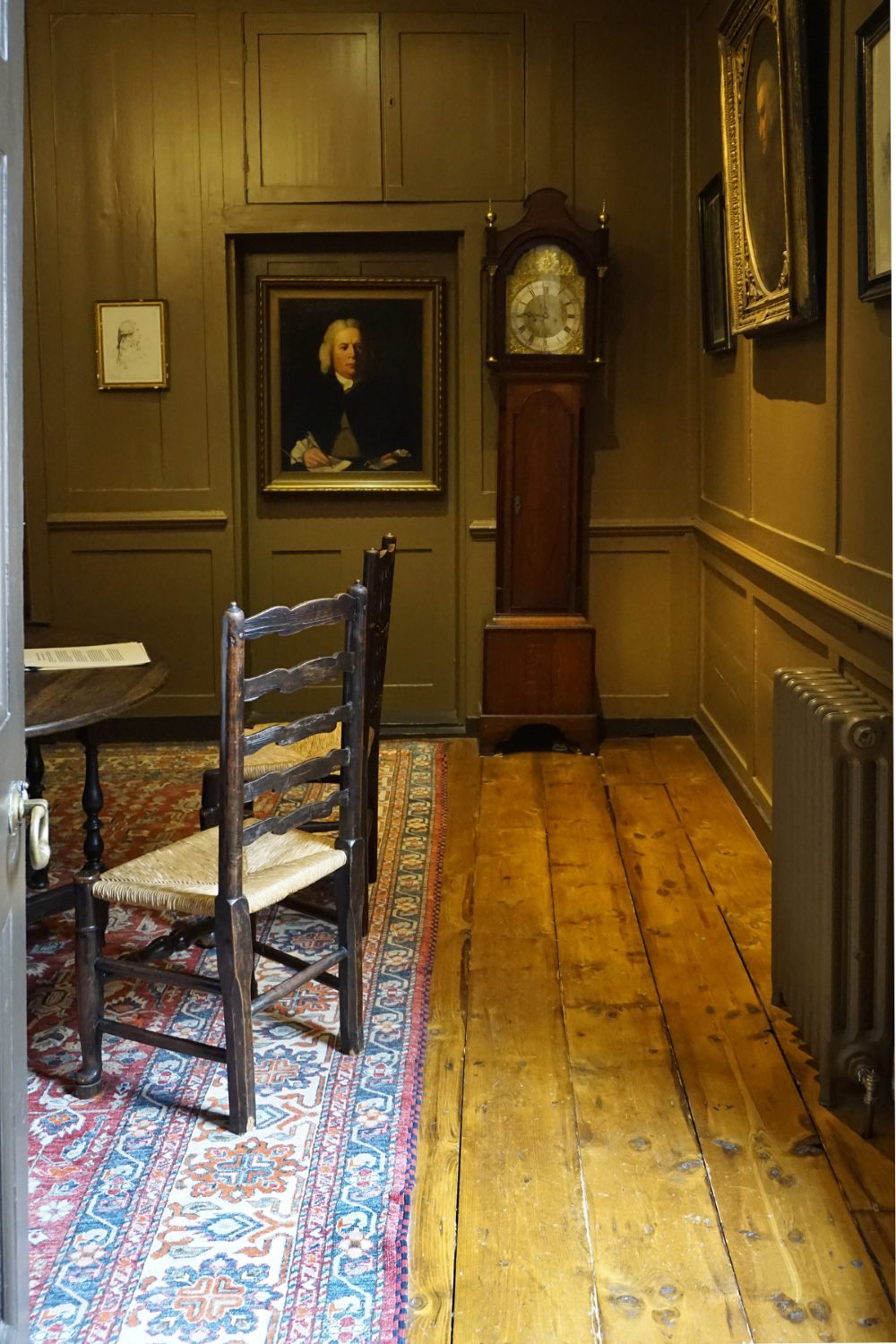
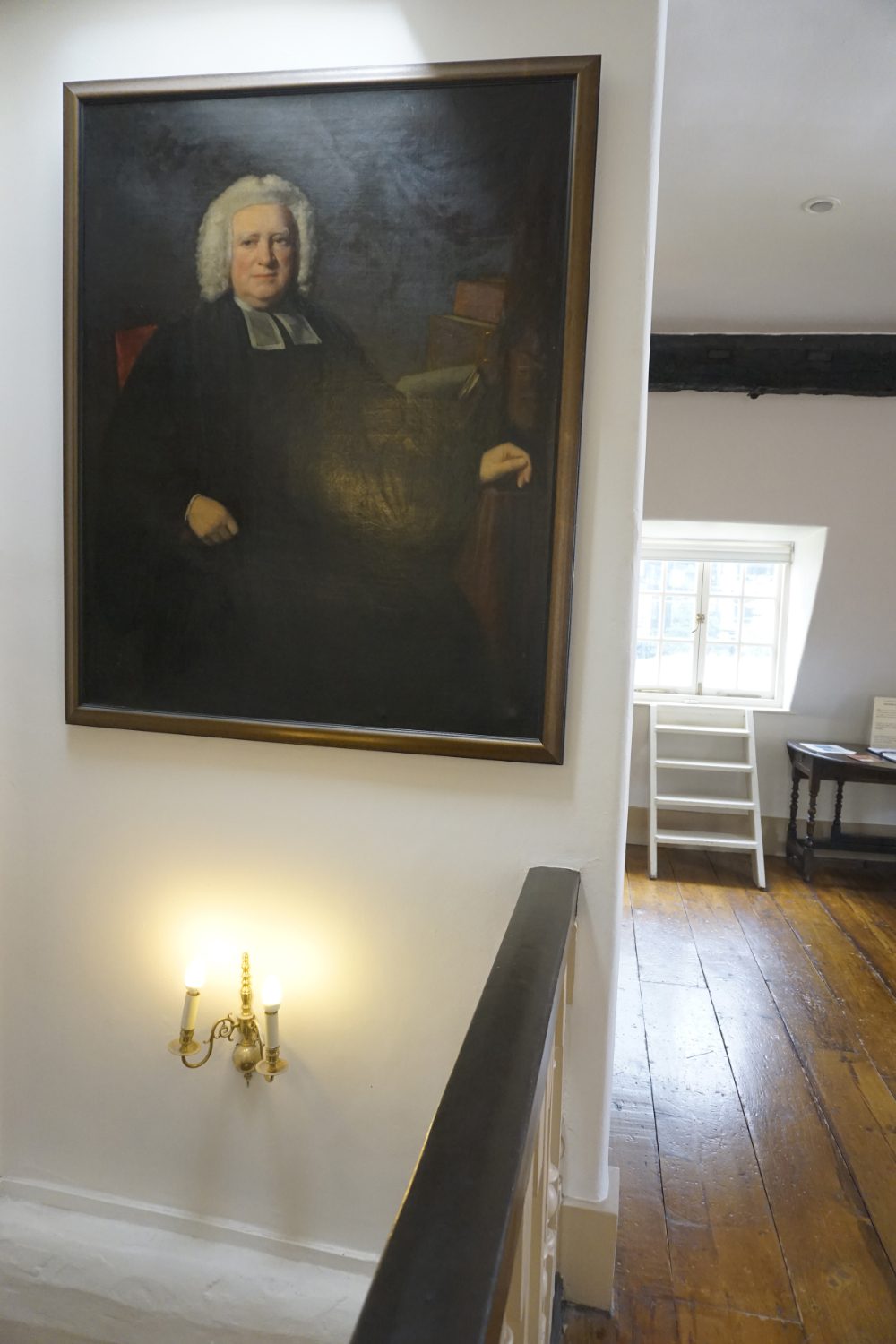
The house in Gough Square is now a museum with thousands of visitors and its walls are crowded with portraits of the giants of the age who became known as Johnson’s ‘circle’. Amongst them are David Garrick, Joshua Reynolds, Edward Gibbon and Oliver Goldsmith. This society of learned men began meeting monthly shortly after Johnson had left this house. But in the winter of 1749, to ease his loneliness, he had founded a small club that met each Tuesday evening at the King’s Head, a tavern in Ivy Lane near St Paul’s. Here, according to his friend John Hawkins, Johnson, in ‘a disposition to please and be pleased, would pass these hours in a free and unrestrained interchange of opinions, which otherwise had been spent at home in painful reflection.’
Social life along with writing, were his only cures for his ‘vile melancholy’. Some of the members of this club became lifelong friends. One, a young and earnest Bennet Langton, recalled meeting Johnson at Gough Square for the first time. Expecting a well-dressed, ‘decorous philosopher’, he was astounded to encounter a man just risen from bed at noon,
a huge uncouth figure, with a little dark wig which scarcely covered his head, and his clothes hanging loose about him. But his conversation was so rich, so animated, and so forcible, and his religious and political notions so congenial…that he conceived for him that veneration and attachment which he ever preserved.
Although Tetty had initially been pleased with the new residence, she started to complain about the noise and noxious air at Gough Square; so at enormous expense, Johnson rented another house for her in Hampstead. For the last few years Tetty had begun a slow but steady decline. She had discovered this big, strange city was not for her and remained proud but timid, existing on the sidelines of the learned, sometimes wild friends Johnson surrounded himself with. It is most likely that she was prescribed draughts of laudanum (opium mixed with alcohol) for a damaged tendon in her foot. This started a habit which, along with an increasing dependence on gin, led to her steady retreat from life. One of Johnson’s closest friends described her as ‘always drunk and reading romances in her bed’.
Inevitably there were disappointments in this marriage. But as Johnson confided to a friend, ‘even ill-assorted marriages were preferable to cheerless celibacy.’ This opting for one kind of disappointment over another came from an outlook forged after his early breakdown, when he learned to more carefully align hopes with reality. Freya Johnston observes that this is one of the most valuable aspects of Johnson’s thinking, ‘a kind of mournful pragmatism’.
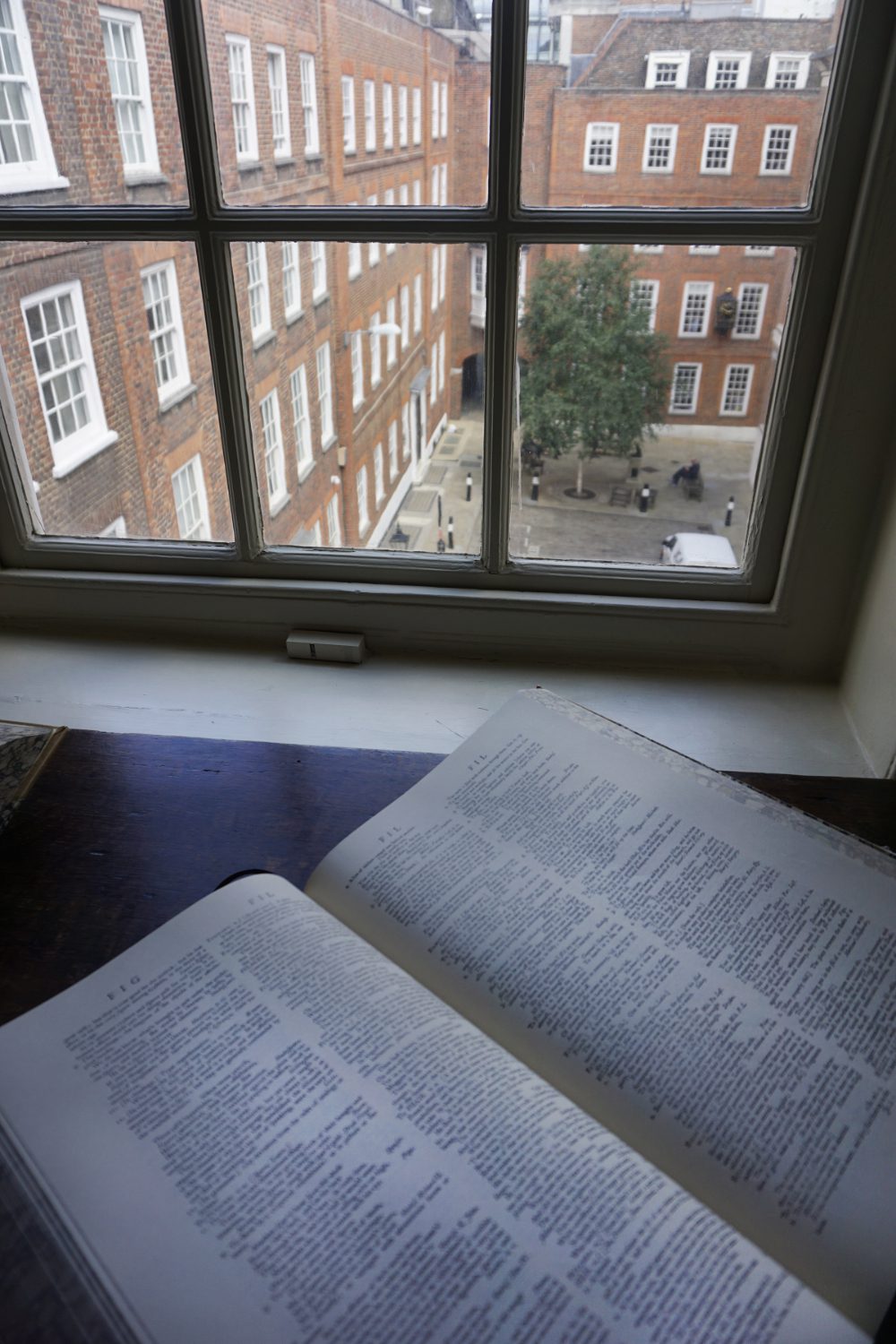
The attic of the home in Gough Square runs the width of the house and is flooded with light from its generous Georgian windows. In Johnson’s day the room was ‘set up like a counting house’ with stand-up desks for his six assistants, five Scotsmen and one Englishman. He had chosen them from the Grub Street world largely out of compassion, relying on one for his knowledge of ‘low cant phrases’. Johnson preferred to work at an ‘old crazy deal table’, perched on a three-legged chair propped up against the wall to keep him upright.
Johnson equated the task of compiling English words to chasing the sun: an endless mission, Sisyphean in nature. The mammoth undertaking to single-handedly determine the definitions and usages of almost every word (over 42,000 of them and 114,000 literary quotations as it turned out) helped solidify English just as it was emerging as a world-wide language. His voracious reading stood him in good stead for his role as a lexicographer since he knew a great deal about rare words and their odd connections. He supplemented his knowledge by meticulously reviewing English literature and scientific works from the sixteenth century onwards, underlining quotes that provided the usage and contextual definitions of words. In the margins he would note the first letter of the word beneath which it would appear.
After finishing a book he would pass it on to an assistant who transcribed each sentence on a separate piece of paper and arranged them under the word to which they referred. Johnson then added the definition, noted the register and tone, and collected the etymologies. Finally the assistants prepared the work sheet by sheet for the printer.
By 1750, after two solid years of work, Johnson had begun to have doubts about his approach. At the outset he had declared his intention to ‘fix the English language’. Now he read an essay by Benjamin Martin who declared:
the pretence of fixing a standard to the purity and perfection of any language…is utterly vain and impertinent, because no language as depending on arbitrary use and custom, can ever be permanently the same.
Martin had confirmed a position Johnson was already reaching: ‘No dictionary of a living tongue can ever be perfect, since while it is hastening to publication, some words are budding, and some falling away.’ As a result he moved from a prescriptive to a more descriptive approach.
Producing the dictionary was a hardship to Johnson, a task demanding no ‘higher quality than that of bearing burdens with dull patience, and beating the track of the alphabet with sluggish resolution.’ It came at heavy personal cost. He slogged away in the face of fatigue, disappointment and ill health. The enormously wealthy Earl of Chesterfield had led him to believe he would patronise the work, but he gave only a very modest contribution and Johnson was desperately anxious about money. Tetty had become gravely ill and her medical expenses had been higher than he could have originally anticipated.
To earn more income and provide ‘relief’ from writing the dictionary, Johnson embarked on The Rambler, the first of a series of moral writings, between March 1750 and March 1752. These essays were published every Tuesday and Saturday. Johnson drew from the wisdom literature of the Greeks, the books of Ecclesiastes, the Humanists of the Renaissance and his own inner life, producing profound reflections on human experience. In their honest self-scrutiny they bear echoes of the work of Montaigne. ‘What should books teach, but the art of living?’ Johnson asked. He wrote how we are ‘all prompted by the same motives, all deceived by the same fallacies, all animated by hope, obstructed by danger, entangled by desire, and seduced by pleasure.’ He confessed to weaknesses and temptations he spent a lifetime battling in himself.
On his bugbear, procrastination, Johnson observed the way it forces life to be ‘languished away in the gloom of anxiety’, while we reconcile ‘ourselves to our own cowardice by excuses which, while we admit them, we know to be absurd.’ He shed light on our frightening tendency to fall into egotism, greed and self-delusion and argued that we are skilled in justifying and rationalising our selfish behaviour, while ignoring uncomfortable truths. He wrote that such traps could be overcome with rigorous self-reflection and a willingness to confront our flaws. After examining all the vices, he marked out envy as the closest to ‘pure and unmixed evil’ because its objective is ‘lessening others, though we gain nothing to ourselves.’ Of all the virtues courage was the greatest, ‘because if you haven’t courage, you may not have an opportunity to use any of the others.’
In one essay he compared humans to Don Quixote, dreaming up projects, exaggerating the benefits and living ‘in idea’. Yet without the motivation of our imaginations and ‘the power of magnifying the advantages’, we might never take a risk at all:
Without hope there can be no endeavour…it is necessary to hope, though hope should always be deluded; for hope itself is happiness, and its frustrations, however frequent, are less dreadful than its extinction.
Johnson even anticipated Freud by observing that when the imagination fails to be satisfied, it can turn into repression. What Freud called ‘defence mechanisms’, Johnson called ‘the stratagems of self defence’, in which the thwarted imagination creates a ‘secret discontent’.
Johnson never took the moral high ground. His religious friend James Beattie once confided to him that he was ‘at times troubled with shocking impious thoughts’. Johnson replied: ‘If I was to divide my life into three parts two of them would have been filled with such thoughts’. Yet, however imperfectly, he continued to bring such thoughts ‘under regulation’. He urged readers to become alive to their responsibilities in the world, to become wiser and more self-aware. He suggested there might be value in shedding light on the darker shades of human nature:
whether to see life as it is, will give us much consolation, I know not; but the consolation which is drawn from truth, if any there be, is solid and durable.
As Johnson’s biographer Jackson Bates adds, in this way we can move ‘closer to the only freedom possible to us – the freedom that comes through the harmony of the inner life with truth.’
Six years into the creation of the dictionary, Tetty’s health worsened and she was moved back to Gough Square for the remaining months of her life. During this time, her son Jervis Henry called at the house. He was now a captain in the navy and up to that point had stayed true to his threat to never see his mother again. He asked to see the mistress of the house, explaining that he was about to go away. Receiving excited instruction from Tetty to bring him up at once, the maid dashed downstairs to the front door, only to discover that Jervis Henry had gone.
Just days before her death, Johnson showed Tetty the bound collection of The Rambler. She told him: ‘I thought very well of you before; but I did not imagine you could have written anything equal to this.’
When Tetty died in March 1752, Johnson was inconsolable. In desperation he sent for his old friend John Taylor, who hurried to him at three in the morning and found him ‘in tears and in extreme agitation.’ Johnson had a terrible fear of being alone and fell into the blackest despair. He later explained to a friend that Tetty’s absence had left him feeling unmoored:
I have ever since seemed to myself broken off from mankind, a kind of solitary wanderer in the wild of life, without any certain direction, or fixed point of view.
Johnson’s wretched state alarmed his friends. A fortnight after Tetty’s death, his friend Richard Bathurst sent him his ten-year-old black servant, Francis Barber, in the hope that by having someone to worry over, Johnson’s spirits would be lifted.
Francis Barber had been born into slavery on a sugar plantation in Jamaica and brought back to England by Bathurst’s father (there were rumours that Francis was his illegitimate son). Having escaped a brutal life of slavery, Francis now faced a hostile reception in England. Racism was being whipped up at the time by a pro-slavery propagandist and there was wide support for a tax on black servants who ‘are become too abundant in this kingdom. In their employments they…stand in the way of our own people.’
Johnson must have seemed large, intimidating and at forty-two, immensely old to Francis, but he was deeply sympathetic. He was an abolitionist way before the abolitionist movement, once shocking an audience at a university dinner by making a toast to ‘the next insurrection of Negroes in the West Indies.’ And having received taunts like ‘barbarous’ and ‘savage’ on account of his personal quirks, he understood how it felt to be an outsider. Francis came along at exactly the right time for Johnson, who was ever grateful to ‘my dear, dear Bathurst’. He sent Francis to school at considerable expense to himself, and put him in charge of general (light) duties at his house. He famously shopped for oysters for Hodge, his cat, fearing that Frank, as he called him, would feel demeaned by such a job. After Frank became ill and unable to attend school, he began to instruct him in reading, writing, Latin, Greek and other languages.
Shortly before Tetty’s death, Anna Williams had moved in to assist as her companion and would remain living with Johnson for the rest of her life. She was a sharp tongued poet, translator and writer who had been rendered almost completely blind by a failed cataract operation. She worked as Johnson’s housekeeper, keeping him well stocked with Johnson’s drug of choice. In order to provide an example to Tetty, he had given up alcohol and become a ’shameless and hardened tea drinker’; it was tea that fuelled his many late night work sessions.
Johnson also recognised Anna’s talent. Together with Garrick, they raised funds to help publish a volume of her writing: Miscellanies in Prose and Verse in 1766. After she died he wrote that she had been his ‘curious’ and ‘knowledgeable’ companion for thirty years and her death had left him ‘very desolate’.
Towards the end of his time at Gough Square Johnson also gave a home to Robert Levet, a doctor who was qualified in France, but unable to practice in England. Instead, he began treating the poor of London’s East End. His services were sometimes paid in glasses of gin and Johnson said ‘he was the only man I know to get drunk through prudence.’ Levet was a dour man of few words. Whoever called in on Gough Square at midday, would find Levet at breakfast with ‘Johnson in dishabille, as just risen from bed, and Levet filling out tea for himself and his patron alternately, no conversation passing between them.’ Johnson found him a reassuring influence. Here was a man who was performing a useful function in the face of disadvantage: a man ‘obscurely wise, and coarsely kind’.
Two years after Francis arrived, Bathurst Senior, who still ‘owned’ the young man, died, leaving him a handsome sum of money and his liberty. Despite his employer’s sympathetic nature, Francis did not wait long to leave. He and the poet Anna Williams had disliked each other from the start and Johnson had often been called on to break up their arguments.
He initially found work with an apothecary and for two years stayed in regular contact with Johnson. Then he joined the navy in the hope of greater freedom. Johnson was appalled, later telling Boswell: ‘No man will be a sailor who has contrivance enough to get himself into jail; for being in a ship is being in a jail, with the chance of being drowned.’ He went to considerable trouble to have Francis discharged. Francis was displeased by this intercession but was packed off to a grammar school to complete his education, regardless. He later became the first black schoolmaster in England and in testament to their affection for Johnson, he and his wife named their son Samuel.
The loss of Tetty seemed to enable Johnson to speed up his efforts on the dictionary. He started the second volume and after refining his methods, began working way ahead of the printer. To ward off the despair to which he was always prone, he maintained his wide circle of friends and by the end of 1874, the dictionary was close to completion. ‘I now begin to see land in this vast Sea of words’, he wrote.
Lord Chesterfield who had been consistent in his lack of financial support, made a belated dedication. This infuriated Johnson who told him that he had done without him during the making of the work and could do without him now, writing to him with some bitterness:
Is not a Patron, my Lord, one who looks with unconcern on a man struggling for life in the water, and, when he has reached ground, encumbers him with help?
Johnson wrote a moving Preface to the dictionary. He reflected on the hope with which he had started the project. But now he lived in an almost empty house, without the assistants that had animated the place and without his wife who had been the primary motivation for undertaking the work in the first place. Here he seems to be saying, ‘take it or leave it, I’ve done my best’:
…it may gratify curiosity to inform it, that the English Dictionary was written with little assistance of the learned, and without any patronage of the great; not in the soft obscurities of retirement, or under the shelter of academic bowers, but amidst inconvenience and distraction, in sickness and in sorrow.
The great leather folio of Dr Johnson’s A Dictionary of the English Language is a monument to his intellect and a labour of his love: a survey of much of the expressive world of English (estimated at about eighty per cent of the English vocabulary of his time) brought sparkling to light. This dictionary stood out because of the clarity of its definitions, Johnson’s skill and wit, and his focus on ordinary, everyday words.
Johnson’s masterwork became the definitive dictionary. Not until the publication of the Oxford English Dictionary, 173 years later, was it superseded. Literary historian Walter Jackson Bate described it as ‘one of the greatest single achievements of scholarship, and probably the greatest ever performed by one individual who laboured under anything like the disadvantages in a comparable length of time.’ When Robert Browning decided to adopt literature as a profession, he qualified himself by reading Johnson’s dictionary from end to end.
Every page of the work is stamped with Johnson’s inimitable style, ‘so redolent of the Sage’s own burly personality’, as Irish poet John Todhunter put it. In many respects Johnson’s dictionary is his truest memorial. Its definitions are often sly and humorous, sometimes at his own expense:
‘Lexicographer’ – ‘A writer of dictionaries, a harmless drudge, that busies himself in tracing the original, and detailing the signification of words.’
‘Dull’ – ‘Not exhilarating; not delightful: as, to make dictionaries is dull work.’
‘Patron’ – ‘One who countenances, supports or protects. Commonly a wretch who supports with insolence, and is paid with flattery.’
‘Grub Street’ – ‘Originally the name of a street in Moorfield in London, much inhabited by writers of small histories, dictionaries and temporary poems; whence any mean production is called grub street.’
‘Oats’ – ‘A grain, which in England is generally given to horses but in Scotland supports the people.’
‘Cat’ – ‘A domestic animal that catches mice, commonly reckoned of the leonine species.’ Johnson then included an illustration of a cat with the caption: ‘A cat, as she beholds the light, draws the ball of her eye small and long, being covered over with a green lens; and she dilates it at pleasure.’
Johnson also made use of Shakespeare’s innovative brilliance with language (there is another story about that here). He extracted 1,800 new words from his works, using Shakespeare’s citations to establish usage, including words such as: lacklustre, hobnob, barefaced, amazement, assassinate and universe.
Johnson’s last piece of writing in the house in Gough Square was also an act of love. Over the course of five days, he wrote his one and only novel Rasselas in the attic where the Dictionary had been made. It exploited a recent interest in oriental romances and he wrote it in order to pay for his mother’s funeral.
In the spring of 1759, he gave up the house as it had served its purpose and was now too expensive to run. He moved to much smaller lodgings nearby at 1 Inner Temple Lane.
Four years later Johnson met James Boswell in a bookshop in Russell Street. Their twenty-one year friendship (until Johnson’s death) became one of the most celebrated relationships in literary history. Boswell initially reported that he had found Johnson living in a ‘very literary state, very solemn and very slovenly.’
In 1762 Johnson’s long struggle with money finally ended when he was awarded an annual royal pension from King George III. Although he was to write dozens of works after his dictionary, including his critical analysis of Shakespeare and literary biography series, his lifelong love of idleness increasingly held sway and he began a far more relaxed routine. Contemporaries believed his writings to be full of wisdom and personal guidance. They came to ask his advice about anything from reading lists to the wisdom of marriage, and he answered them fully, in down to earth terms. Boswell observed one of his typical days:
About twelve o’clock I commonly visited him, and frequently found him in bed, or declaiming over his tea, which he drank very plentifully. He generally had a levee of morning visitors, chiefly men of letters…and sometimes learned ladies…He seemed to me to be considered as a kind of public oracle, whom every body thought they had a right to visit and consult; and doubtless they were well rewarded. I never could discover how he found time for his compositions. He declaimed all the morning, then went to dinner at a tavern, where he commonly staid late, and then drank his tea at some friend’s house, over which he loitered a great while, but seldom took supper. I fancy he must have read and wrote chiefly in the night, for I can scarcely recollect that he ever refused going with me to a tavern…
Towards the end of his life, Samuel Johnson with his usual ‘mournful pragmatism’ had this to say about dictionaries:
Dictionaries are like watches, the worst is better than none, and the best cannot be expected to go quite true.
‘Thou Soft Flowing Avon’, sung by Emma Kirkby, played by The Parley of Instruments, composed by Thomas Arne, lyrics by David Garrick
Samuel Johnson had no ear for music but he was a keen theatre goer. He had a lifelong reverence for Shakespeare, the supreme ‘poet of nature’ and deeply admired the way the Bard holds up a faithful ‘mirror of manners and of life’. Doubtless he saw his friend David Garrick perform a number of leading roles in Shakespeare’s plays.
In 1769 Garrick created a musical and theatrical celebration marking Shakespeare’s Jubilee in Stratford-upon-Avon. He commissioned Dr Thomas Arne (known for ‘Rule, Britannia’) to compose music to be performed over the two day event. It included ‘Thou Soft Flowing Avon’, a song with lyrics written by Garrick praising the river that runs through Shakespeare’s birthplace. It was a key part of Garrick’s theatrical centrepiece: ‘Ode to the Genius of Shakespeare’.
Johnson stayed away, suspecting the Jubilee would probably be an absurd, rather trivial affair. He turned out to be right. The townsfolk of Stratford were suspicious of the event from the start. Lamps and materials sent from London for the construction of the stage arrived in Stratford smashed to pieces. There was insufficient lodging for the audience who were forced to sleep on blankets in sheds and stables. On the second day the planned pageant was cancelled due to a downpour, much to the delight of locals. But ‘Thou Soft Flowing Avon’ (which by then was a raging torrent) was successfully performed indoors.
Samuel Johnson was a literary hero to so many great writers. Argentinian writer Jorge Luis Borges particularly admired the way he explored all the nuances of morality while making his own personal weakness the subject. Borges, an ardent Anglophile had surprised an audience on a visit to England by stating that such an empirical approach made Johnson even more English than Shakespeare.
John Ruskin, having been introduced to Johnson’s moral writings by his father wrote that,
I at once and for ever recognised in him a man entirely sincere, and infallibly wise in the view and estimate he gave of the common questions, business, and ways of the world…No other writer could have secured me, as he did, against all chance of being misled by my own sanguine and metaphysical temperament. He taught me carefully to measure life, and distrust fortune.
Jane Austen called him her ‘dear Dr Johnson’ and considered him to be her ‘favourite author in prose’. She particularly enjoyed Johnson’s attacks on what he called ‘cant’, ‘a whining pretension to goodness’, and our tendency to self-delusion. Gloria Cross argues here that Austen incorporated many of Johnson’s ideas about marriage and families in her novels.
Virginia Woolf called for sainthood for Samuel Johnson. She borrowed the title of her essay collection The Common Reader from one of his essays. Like Johnson, her essays examine literature from the perspective of a passionate enthusiast who reads for pleasure. She also used Johnson’s essay structure which combines literary biography with criticism, and she emulated the way he could ‘enliven a subject’ by selecting the most ‘shining’ and revealing facts.
The house at 17 Gough Square, just north of London’s Fleet Street, is handsome and well proportioned. It is a privilege to be able to walk through its wood panelled rooms, up the original staircase Johnson compulsively had to touch, and peer through the exact windows he looked through while compiling his great dictionary in the attic.
Virginia Woolf who often visited this house, wrote how
writers stamp themselves upon their possessions more indelibly than other people. Of artistic taste they may have none; but they seem always to possess a much rarer and more interesting gift – a faculty for housing themselves appropriately, for making the table, the chair, the curtain, the carpet into their own image.
Johnson’s house feels convivial and warm. It may have been prone to London’s ‘noxious fumes’ according to Tetty, but it is tucked away in a secluded square, far from noisy streets. I can imagine in its ample and comfortable rooms Johnson would have easily fallen into the type of deep concentration his work on the dictionary required.
After Johnson left the house it was used as a tenement and later as a printing workshop. In 1911, Cecil Harmsworth, a Liberal MP, bought the then dilapidated building, saving it from demolition. He had it sensitively restored and opened it to the public as a museum in 1914.
During the Second World War the house was used as a lookout and social club for the Auxiliary Fire Service. In 1940 the roof was blown off by a bomb but the building was rescued because the auxiliary fireman were downstairs at the time.
In the courtyard of Gough Square outside Dr Johnson’s house is a bronze statue of Johnson’s cat Hodge, created by sculptor Jon Bickley and installed in 1997. Hodge sits on top of a copy of the dictionary, next to empty oyster shells. Visitors often leave coins in the shells for good luck. The monument is inscribed with the words ‘a very fine cat indeed.’
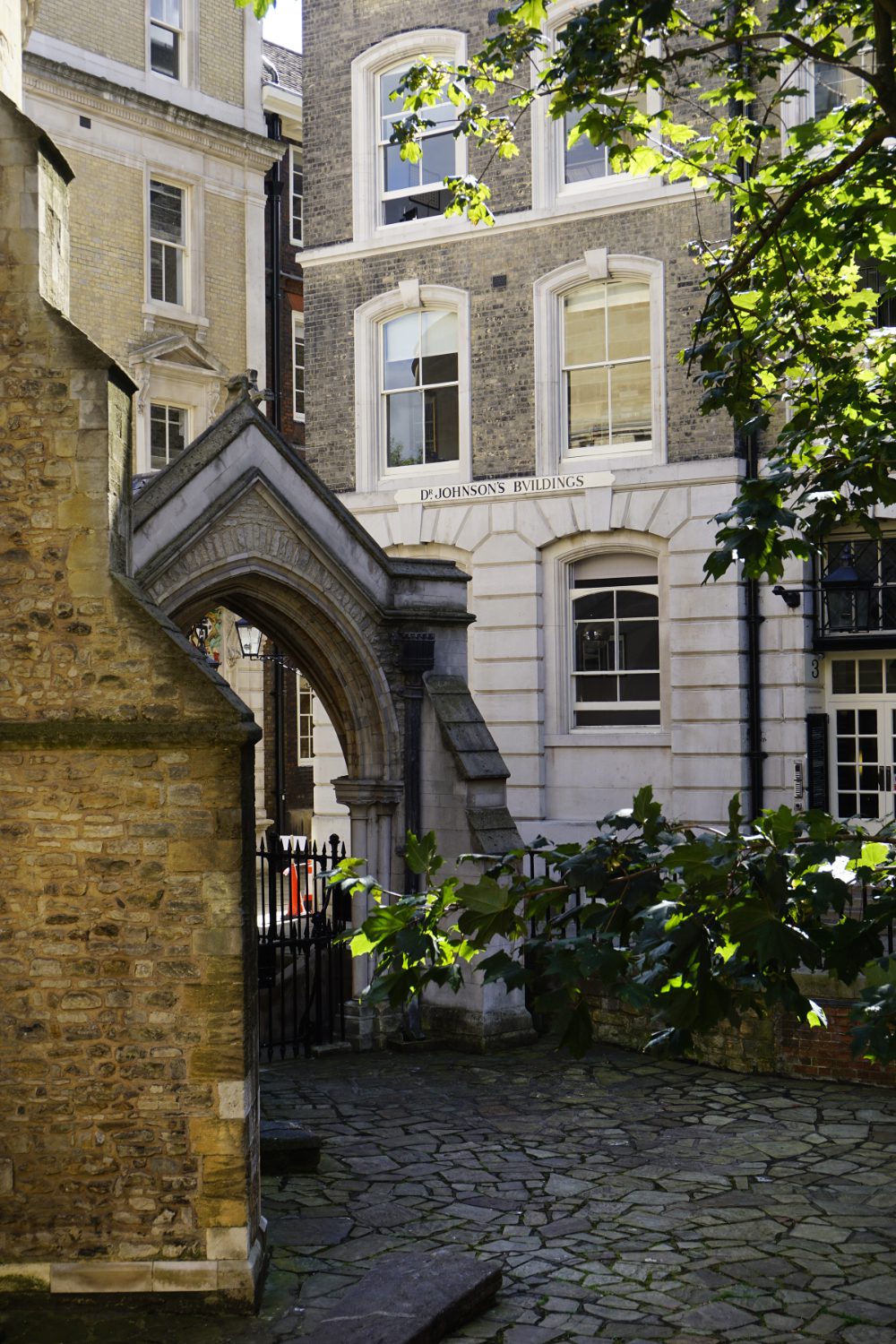
After my visit to the house I joined a guided walking tour offered at the museum. The tour included a visit to 1 Inner Temple Lane in the heart of London’s legal district, which became Johnson’s home after he moved from Gough Square. The Lane runs adjacent to the twelfth century Temple Church which is connected to the Knights Templar (it was featured in Dan Brown’s The Da Vinci Code). In the graveyard of this church lies a stone memorial to Johnson’s great friend, Irish novelist and playwright Oliver Goldsmith. A statue of Samuel Johnson can be found on the Strand nearby, in the churchyard of St Clement Danes church. On the front of the plinth on which the figure stands is a portrait in relief of Johnson’s biographer and devoted friend, James Boswell, to whom Johnson once said: ‘My regard for you is greater almost than I have words to express.’
Dr Johnson’s House has a research library and is full of Johnson related material. Aside from the permanent collection, the museum hosts regular readings and exhibitions.
You can view Johnson’s Dictionary here.
Here is Robert McCrum’s rationale for including Johnson’s A Dictionary of the English Language in his 100 best nonfiction books of all time.
Blackadder’s wonderful send up of Johnson and his dictionary, portrayed by the late Robbie Coltrane.
A reassessment of Johnson’s neglected play Irene has been found to challenge traditional assumptions about Johnson as an irrelevant, dead white man.
Ackroyd, Peter. London: The Biography, Vintage, 2001
Bate, Walter Jackson. Samuel Johnson: A Biography, 1998
Boswell, James. Boswell’s Life of Johnson, Oxford University Press, 1924
Hitchens, Christopher. Arguably: Essays, Hachette, 2011
Hitchings, Henry. ‘The Fortunes of Frances Barber by Michael Bundock review – saved by Samuel Johnson’, The Guardian, 25 April, 2015
Holmes, Richard. Sidetracks: Explorations of a Romantic Biographer, Vintage, 2000
Hudson, Nicholas. ‘Samuel Johnson’, in Grub Street Project, October 2022
Johnston, Freya. ‘I’m coming, my Tessie!’, London Review of Books, Vol. 41 No. 9, 9 May 2019
Martin, Peter. Samuel Johnson: A Biography, Weidenfeld & Nicolson, 2008
Nokes, David. Samuel Johnson: A Life, Faber and Faber, 2009
Sutherland, John. Lives of the Novelists: A History of Fiction in 294 Lives, Profile Books, 2011
Tagholm, Roger. Walking Literary London: 25 Walks through London’s Literary Heritage. New Holland, 2001
Wain, John, Samuel Johnson in Writers and Their Houses, Ed. Kate Marsh, Hamish Hamilton 1993.
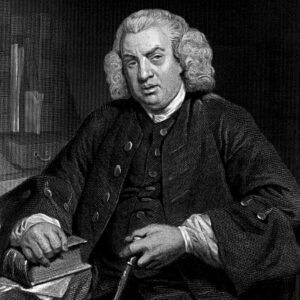
Samuel Johnson (1709 – 1784) was an English writer and polymath who made lasting contributions as a poet, playwright, essayist, moralist, literary critic, sermonist, biographer, editor, and lexicographer. The work for which he is best known is his Dictionary of the English Language (1755).