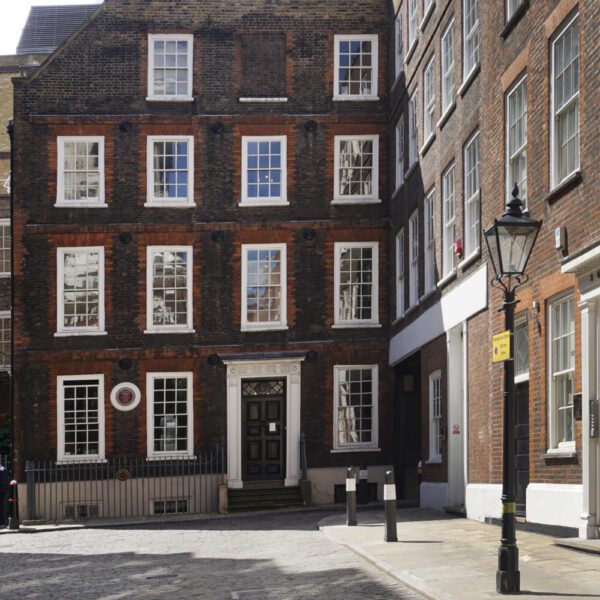
The Literary Lion of London, Samuel Johnson
17 Gough Square, London
A story about how this extraordinary man came to write one of the most important and famous books ever published.
Music: Almond Blossom, Remko Kühne

In a letter to his sister Willemien, Vincent van Gough describes the effect of the light in the south of France on his way of seeing.
What strikes me here and what makes painting here attractive to me is the clarity of the air, you can’t know what that is because it’s precisely what we don’t have at home - but at an hour’s distance one can make out the colour of things, the grey-green of olive trees and the grass green of the meadow, for instance, and the pink-lilac of ploughed land; at home we see a vague grey line on the horizon; here the line is sharp and the shape recognisable from far, far away. This gives an idea of space and air.


Vincent van Gogh headed for the South of France from Paris in February 1888 to seek a different, brighter light that he hoped would release the flat, clear colours he so admired in the Japanese ukiyo-e prints he had seen in Paris. He also longed for the peace of the countryside and, like so many northerners, he craved the warmth and radiance of a stronger sun.
Vincent was a man you would look at twice. He appeared older than his thirty-five years, his forehead prematurely wrinkled, brows knitted together in a frown of concentration, red hair cropped short and small, deep-set eyes that were sometimes blue, sometimes greenish. His sister Elisabeth described him as ‘broad rather than slender, his back slightly bent from the bad habit of hanging his head…Despite this unprepossessing exterior, the unmistakeable suggestion of inviolate depths gave a kind of strangeness to his whole person.’
The two years he had spent in Paris had been invaluable. Initially he was stimulated by the city’s intellectual atmosphere and the treasures that were to be discovered in its art galleries. He saw original works by the Impressionists and a new generation of artists including Paul Gaugin, Henri de Toulouse-Lautrec and Georges Seurat. Absorbing lessons from the Impressionists, he renounced his dark canvases for a brighter palette. But, as with Paul Cézanne, Vincent was not wholly won over by their approach. He felt their emphasis on light came at the expense of drawing, form and construction and he had always believed that ‘drawing is the root of everything’.
Once the excitement of the attractions of Paris had passed, life in the city began to grate on his nerves. Vincent became disillusioned by the petty rivalries and squabbles of the art world. The cold of his second winter there seeped into his bones and left him feeling empty and ‘dimmed with sadness’. He grew increasingly irascible and hit the bottle, particularly absinthe. By the end of his stay his health was shot and he had managed to pick quarrels with nearly everyone he knew.
This tended to follow a pattern for Vincent. He would often arrive at a new place full of optimism, only for his hopes of a fresh start to be dashed by some difficulty or upset. As a consequence, for much of his life he trod a solitary and tortured path, ‘wandering’, as he said, ‘like a tramp, perpetually misunderstood, remaining a stranger to most.’ ‘A great fire burns within me but no one stops to warm themselves at it, and passers-by only see a wisp of smoke’, he wrote to his brother Theo.
Being misunderstood had started early for Vincent. He was the eldest of six children, born to a pastor and his rigidly religious wife Anna in Zundert, a remote municipality in the Netherlands. Born exactly a year after a stillborn brother who had also been called Vincent, he was a replacement child. A number of his biographers believe this was the root of serious problems that plagued him for the rest of his life, making him feel like an outsider, an imposter, someone who never quite measured up to the ideal image of the firstborn. His mother had been grief stricken by her loss and it is possible that she failed to bond with her second child. In any case, they rarely got along, and as Vincent grew older, she grew to actively dislike him.
The family’s lives were narrow and monotonous, governed by Calvinist austerity. They prized piety and conformity: any deviation from life’s straight path was greeted with horror. What they had in Vincent was a sensitive yet plucky boy with a fierce intelligence, who was alive to nature and curious about the world around him. He would take long solitary walks across the fields and marshes where he watched birds, gathered plants and brought home insects to collect and study. These were not polite rambles in the countryside; he took off in all weathers, and if it was night and in the middle of a storm, all the better.
Much as they loved a stroll in the country, Vincent’s parents were quick to miscast their son’s passion for nature as uncivilised and his independence of mind as wilful disobedience. It is possible that the fits of temper, that his grandmother had called his ‘insufferable outbursts’, arose from feelings of being misunderstood.
Nonetheless, Vincent was always loyal to his family and there were riches to be had here too that would later inform his art. He had acute empathy for others and all his life looked out for the underdog. Regular visits to the poor with his father helped him to develop a sensitivity to social injustice, which became a theme of his early paintings. They depicted the harsh, honest lives of labourers. It was a subject that preoccupied him for much of his career as a painter.
Initially Vincent wished to follow his father as a pastor but his enthusiasm for religion lasted only until his mid twenties. He grew disillusioned with formal bureaucratic church doctrine and, like Thomas Hardy, began to believe that God was just as likely to be found in nature and human experience as in a church. Some of Vincent’s later paintings contain symbolic religious themes and a deep connection to the sacred in nature.
As well as the Bible there was literature and plenty of picture books available to Vincent and he feasted on stories: Dickens (his favourite writer), Victor Hugo, Émile Zola, Balzac, Harriet Beecher Stowe, George Eliot and the poetry of John Keats. He described reading as a ‘need to eat bread’. A deep knowledge of literature informed Vincent’s responses to his surroundings: he would often see people and places though the eyes of writers, their fictional places and characters that he knew and loved. His reading constantly enriched and deepened his ideas about art and he came to view painting as a form of literature without words.
As he grew older Vincent increasingly lived by rules that were unsparing and he was subject to unappeasable passions. ‘I am a fanatic!’ he declared in 1881. ‘I feel a power within me…a fire that may not quench, but must keep ablaze.’
Apart from a strong bond with his younger brother Theo, achieving closeness with others was fraught with difficulty for Vincent. Most members of his family, friends and fellow artists had at one stage or other felt threatened by his passionate nature, his intense manner of speaking and his anger. People in his neighbourhood kept out of his way, regarding him as an eccentric good-for-nothing. Even his devoted brother Theo had sighed with relief when Vincent moved out of their shared apartment in Paris. He wrote to their sister Willemien that his brother seemed to contain two people: ‘one marvellously gifted, refined and gentle, and the other selfish and unfeeling.’ He added that since living with Vincent:
my home life is almost unbearable, no one wants to come and see me any more, because it always ends in quarrels, and besides he is so untidy that the room looks far from attractive. I wish he would go and live by himself, he sometimes speaks about it…I only ask him one thing, to do me no harm…
Vincent was aware that he was a ‘highly strung’ individual who only had himself to blame when others found him ‘disagreeable’:
I’m often terribly cantankerously melancholic, irritable – yearning for sympathy as if with a kind of hunger and thirst – I become indifferent, sharp, and sometimes even pour oil on the flames if I don’t get sympathy. I don’t enjoy company, and dealing with people, talking to them, is often painful and difficult for me.
He believed that nervousness lay at the root of a great deal of these troubles, allied with his extremely sensitive nature.
Eight years prior to travelling to the south of France Vincent had exchanged his fervent religious vocation for an artistic one. At the age of 27, following his decision to become a fully fledged artist, he was gripped by commitment and passion. ‘It’s no use hesitating or doubting’, he wrote to Theo in 1882,
the hand may not tremble and the eye may not wander but must remain fixed on one’s purpose. And one must be so engrossed in it that something quickly takes shape on the piece of paper or the canvas, where at first there was nothing, so that later one hardly knows how one tossed it off. The time of reasoning and selecting must precede the decisive action. While doing it there’s little space for reflecting or reasoning.
Initially his drawings were mediocre. But Vincent set about teaching himself with extraordinary focus, putting his whole heart into it, and he developed as an artist with extraordinary speed. Being largely self taught, Vincent was able to stay faithful to his own vision and ’render things with originality’, as he put it. Within a few years he was producing work that is uncompromising, passionate and full of energy. His ultimate ambition was to make art that touched people:
I want to progress so far that they will say of my work: He feels deeply, he feels tenderly – notwithstanding my so-called roughness, or perhaps even because of it.
Depression plagued Vincent all his life but like Cézanne, he would ward it off with strenuous bouts of work. During a particularly dark period in his life he wrote to Theo:
I hope that perhaps a certain frenzy and rage of work may carry me through as a boat is sometimes thundered by a wave over a cliff or sand bank, and profits by a thunderstorm to save itself from being wrecked. After all, if I fail, for what is lost in me I don’t care so much. But in general one seeks to make one’s life bear fruit rather than let it wither.
And so there he sat on the train to Arles, just fifty miles from where Cézanne was living and working in Aix-en-Provence. Soon other French modernist painters would follow, in search of the blazing light: Signac to St Tropez, Matisse to Nice, Derain to Collioure. A stint in Provence would become as obligatory as their eighteenth century forebears’ trips to Rome.
As his train approached the town, Vincent stuck his head out of the window to take in the scene. The land was low and strikingly reminiscent of Holland with its flat fields, marshes and windbreaks. Like his homeland, much of it had been reclaimed. Arles, situated near the point where the Rhône river meets the Mediterranean, had been a virtual island until a drainage canal was built in the sixteenth century. Laurence Durrell described it as ‘perched on the edge of a watery delta with its back to the infernal mistral’. Although it had briefly been the capital of the Western Roman Empire, Arles had fallen on hard times and many now found it tawdry and run down. Vincent knew about it only from the novels of Alphonse Daudet, particularly his comic adventure stories about the hero Tartarin: Tartarin de Tarascon (1872) and Tartarin sur les Alps (1885). His expectation, based as it was on fictitious bonhomie and optimism, fell short of the real place. He wrote to Theo:
I don’t find the southern gaiety here that Daudet talks about so much, on the contrary, an insipid affectation, a sordid carelessness…
He was also disinterested in the remmants of the ancient Roman world that lay embedded about the town’s old streets and called the gothic porch of Saint-Trophime ‘cruel, monstrous’, ‘like a Chinese nightmare’. Vincent was far more interested in the modern aspects of life in Arles: the activities on and off the river, the boats, trains, bridges and factory chimneys all caputred his attention.
Although he had only intended to make a short visit, Vincent kept finding reasons to stay. He fell in love with the surrounding countryside and felt those artists who had come to the south of France before him had failed to capture its uniqueness. ‘Good Lord, I have seen things by certain painters which did not do justice to the subject at all. There is plenty for me to work on here.’ And he wrote to Theo: ’Here I am seeing new things’, ‘I am learning’.
Unusually, that February was cold and snowing but snow did not deter the man from the north. From the minute he arrived, he began to work with ‘the lucid and exclusive concentration of a lover’. His first painting was a scene of the surrounding countryside of Arles with the town in the background under a clear blue sky. He wrote to Theo:
I must tell you that at the first fall the snow was almost two feet deep everywhere. It’s still falling…I’ve seen magnificent red vineyards, backed by mountains of the subtlest lilac. The snow-scenes, with their white peaks as luminous as the snow itself, were very like the winter landscapes painted by the Japanese.
Soon gusts of mistral, the fierce, cold, northwesterly wind that blows along the Rhône valley from the Alps, had swept away the winter. Vincent was overawed by the great plane trees bursting with sap, the red earth resembling flesh, and the sky ‘a hard blue in the glitter of a splendid sun’. The transformation of the landscape amazed him. He felt transported to a different world: one without shadow, the limpid light revealing clear outlines and brilliant colour, endowing the scenery with the same harmony and intensity of the Japanese art he so admired.
This was everything he had hoped for and it forced him to revise his interpretation of nature. Now all his hard work and learning crystallised into something new. Gone were his former styles of painting: the sombre realism and ‘dark style’ of his Belgian and Dutch period. Gone went the brighter but subtly realistic studies influenced by the Impressionists of just a few weeks before.
In their place Vincent produced a revolutionary new kind of art that was entirely his own. He painted nature, people and objects with choppy yet sinuous brushstrokes and used seductive, luminescent colours that expressed emotion. A few years before he had wondered why he was not more of a colourist. Now he explained to his sister Willemien that nature in the south could never be painted in the greys of the northern palette, it required a veritable rainbow of colours: ‘sky-blue, orange, pink, vermilion, a very bright yellow, bright green, wine-red, violet.’ Vincent began to simplify form and introduce diagonal compostions which brought him close to the Japanese. He left canvases bare in some places and slathered thick paint (impasto) in others to create texture that felt ‘alive’. He sacrificed accuracy and perfection, ‘playing hell’ with the ‘truthfulness’ of line, proportion or shadow, to bring the likeness that interested him to the fore. As Alain de Botton writes, Vincent wanted to achieve a different type of realism,
behaving like a poet who, though less factual than a journalist in describing an event, may nevertheless reveal truths about it that find no place in the other’s literal grid.
These were works of genius, painted in bursts of ecstatic creativity that revealed the state of Vincent’s very soul. It was a style that would become a precursor to Expressionism.
The orchards had now burst into bloom with the pink and white blossom of the cherry, almond, pear and peach all sparkling in the sun and Vincent embarked on an orgy of painting. He wrote to Theo:
I have been working on a canvas in the open air in an orchard – lilac ploughland, a reed fence, two rose-coloured peach trees against a sky of glorious blue and white. Probably the best landscape I have done.
Working ‘furiously’ in order to capture the fragile, fleeting nature of the blossom, he pegged down his easel to secure it against the wind. ‘Nothing stops me working, I can’t resist such beauty.’ He had recently read a declaration by the writer Guy de Maupassant that the artist is at liberty to exaggerate and create ‘a world more beautiful, more simple, more consoling than ours’. The fourteen paintings of orchards in bloom that Vincent produced in a month are a testament to that sentiment. His line is surer, with just a few strokes giving the impression of contour, volume, space and light. He envisaged them hung in threes to form triptychs, like religious paintings.
Vincent also thoroughly explored the countryside around Arles and painted its canals and drawbridges, its avenues of trees and farmhouses in fields.
This outdoor life had improved his health and morale. He told Theo that he was less at the mercy of his passions and able to work more calmly. The fresh air had the comical effect of making him tipsy after just one small glass of brandy, so he was drinking less. And he discovered that once he drank less, he smoked less, and he ‘began again to think instead of trying not to think’.
These early letters to Theo and his friends Paul Gaugin, Toulouse-Lautrec and Émile Bernard bubble over with enthusiasm. In the streets of Arles he was delighted by
the zouaves [French soldiers], the brothels, the adorable little Arlésienne girls going to their first communion, the priest in his surplice looking like a fierce rhinoceros and the absinthe drinkers – all seem to me creatures of another world.
In these first ecstatic months in Arles, Vincent felt increased confidence in his art, sensing he would make great progress. But Arles was more expensive than he had anticipated and the many tubes of paint and canvases he needed for his paintings were costly. He directed Theo to send him more materials, as this will ‘reduce my expenses here by more than 50 per cent’.
Such a peremptory tone might be forgiven because he viewed himself as being involved in a partnership with his younger brother. Although they had fought one another in Paris, the old love and friendship that had bound them since childhood was never broken. Theo, ever gentle and trusting, was now a successful art dealer and Vincent’s late decision to become an artist was largely due to his brother’s encouragement. From the start, Theo had been in a position to provide Vincent with a monthly allowance, enabling him to commit himself completely to painting. He was the only one to truly understand Vincent and helped him to bear the burden of his life, becoming a refuge from the ‘hostile world’ and a source of constant emotional support.
In 1884, feeing uneasy that he was taking too much, Vincent proposed an arrangement to which his brother agreed: the money and art materials Vincent received would be treated as earnings, and in return all the paintings and drawings he produced would belong to Theo. In numerous letters Vincent referred to ‘our work’ and ‘our pictures’. ‘I insist that you will have created them as much as I, and that we are fashioning them together.’
Ever grateful he wrote to Theo:
You are kind to painters, and I tell you the more I think, the more I feel that there is nothing more truly artistic than to love people. If what one is doing looks out upon the infinite, and if one sees that the work has its vital principle and continuance beyond, one works with more serenity. So you have a double right to that serenity.’
Although their relationship appeared one-sided, Theo later confided to his wife Jo that he depended heavily on Vincent, who had become ‘adviser and brother to both of us, in every sense of the word.’
At the beginning of May, Vincent moved into rooms at No 2, Place Lamartine, near the station, in the right wing of a building ‘painted yellow on the outside, with a whitewashed interior, full of sunlight’. He kept one room to live in and and left the rest as a studio. He wondered whether he might entertain a woman there but decided it would not be private enough for a ‘petticoat episode’. Apart from a brief relationship in the Hague, his love for women had been either thwarted or unrequited. To be united with a woman in love had been one of the strongest desires of Vincent’s adult life but it was doomed to frustration. He seemed to reach a level of acceptance about his single state, as he wrote to Theo:
with my temperament, to lead a wild life and to work are no longer compatible at all, and in the given circumstances I’ll have to content myself with making paintings. That’s not happiness and not real life, but what can you say, even this artistic life, which we know isn’t the real one, seems too alive to me, and it would be ungrateful not be be content with it.
During his time in Arles, Vincent increasingly felt that his love of art meant loss of ‘real love’, writing to Émile Bernard: ‘better live like as a monk who goes to the brothel once a fortnight – I do that, it’s not very poetical – but anyway – I feel that my duty is to subordinate my life to painting.
The promising radiance of sunlight in the spring tipped into full-blown, pulsating brilliance by summer and for a short while Vincent felt uncertain how he might translate the fierceness of the light into paint. ‘One must exaggerate the colour still more,’ he decided.
June heralded the beginning of the harvest in Arles, and Vincent returned to earlier themes. In the Netherlands he had obsessively painted workers in the fields. It was a subject he loved, reminding him of the times he had sought refuge in the patchwork sea of corn, wheat and rye fields that had lain beyond the garden gate of his childhood home. The van Gogh children had called these fields ‘the land of desire’.
To reach the best rural views of the harvest, Vincent’s preferred route out of town was the road to Tarascon (avenue de Montmajour). He completed a painting of himself trudging off to work down this road, wearing his straw hat and blue overalls, ‘dusty, always more laden like a porcupine with sticks, easel, canvas’, the tools of his ‘dirty and difficult trade’, looking just like the rural worker he felt himself to be. Vincent picked reeds growing by the roadside that he sharpened into ink pens. They were more flexible than steel nibs, allowing for a mixture of bold strokes, dots and stippling that he used for his drawings of landscape. He wanted Theo to turn these into sketch books like the books of original Japanese drawings.
The road leads across the plain of La Crau to a rocky hilltop crowned by the ruins of the twelfth century Abbey of Montmajour. Vincent turned his back on the abbey, choosing to draw and paint the panoramic view extending from the small historic village of Fontvieille to the north, Arles to the south, and the flat expanse of the Crau with fields of ripening corn and wheat in between. He painted these fields with their haystacks and sheaves of wheat in shimmering yellow, flaming copper, gold and bronze under a deep blue Mediterranean sky. His aim was to get at the ‘inner character [of the countryside] so that it’s not something vaguely experienced, but the true soil of Provence’, as he wrote to Émile Bernard, adding:
It’s a question of giving the sun and the blue sky its full force and brilliance, and yet not ommitting the fine aroma of wild thyme which pervades the hard-baked, often melancholy landscape.
Some of Vincent’s best drawings were done of this view. Again and again he climbed the Montmajour rock to survey the Crau and its ‘distant perspectives, broad and peaceful, in horizontal lines’. The drawings he made of this scene were radically different from the largely tonal drawings that went before. He had admired the Japanese draughtsmen who could depict a landscape with a few simple strokes of a brush, but Vincent devised an approach that was all his own. Now he broke down the patterns of the landscape into a codified system of marks, in vigorous scrawls, dots, hatching, that evoke light, air, heat and distance. As Robert Hughes points out, Vincent was ‘inventing a landscape as it invents him’.
In June he painted Farm in Provence, The Cornfield, Haystacks, Marketgardens on the Crau.
From morning to night he worked nonstop, battling the heat, the mistral and mosquitoes. To Émile Bernhard he wrote:
I even work [here] right in the middle of the day, in the full sun, with no shade at all, out in the wheat fields, and lo and behold, I am happy as a cicada. My God, if only I had known this country at 25 instead of coming here at 35! At that time I was fascinated by grey, or rather lack of colour.
In the evenings he would drag himself back to Arles, exhausted by ‘the furnace of conception’, and either headed to a cafe to unwind ‘with a good drink and by smoking very hard’, or stayed at home reading Balzac or the Bible.
More landscapes followed in July, ‘done quickly, quickly, quickly, like a reaper who is silent under the burning sun, concentrating on his corn-cutting.’ Although these works were produced at speed, they were never casually churned out. Pierre Cabanne writes that Vincent’s work ‘is logical as well as lyrical, it combines reason with effervescence, drive with spontaneity.’ Vincent said that ‘labour’ as well as ‘dry calculation’ were involved, ‘in which one’s mind is extremely tense, like an actor on the stage in a difficult part, where one must think of a thousand things at the same time, within half an hour.’ These works emerged with the confidence that is hard won from experience, when brushstrokes ‘come with a continuity and a coherence like words in a speech or a letter’ so that ‘one must strike while the iron is hot.’ They had the speed and virtuosity of the best Japanese painters. He found he no longer needed to draw the design in charcoal on the canvas, he was able to start it ‘with the colours themselves’.
Vincent continued to feel exhilarated by all that he saw in Arles. One evening in August, after spending the day painting a new canvas, he wrote:
Nature here is extraordinarily beautiful, all of it, everywhere. The dome of the sky is an admirable blue. The rays of the sun are pale saffron…I’m beginning to feel quite a different person from the man I was when I first came. I have no more doubts and never hesitate when I start anything…I’m so happy with this house and my works…
He painted the public parks and gardens of Arles, their cedars, pines, cypresses, and ‘crazy’ oleanders, frequently enlivened by pairs of strolling lovers. ‘To-day again, I’ve worked from 7 in the morning till 6 in the evening, only stopping once to take a bite round the corner…at present I see my work with perfect clarity and love it blindly.’
Although his passion was the driving force behind such extraordinary productivity, Frank Elgar notes that a further motivation was his sense of duty to pay by his own labour the debt he owed his brother. Vincent painted not only because painting had become a necessity, but also in the hope that his pictures would sell, reimbursing Theo for his generosity. He lamented that this goal was still a long way off.
Although he was a loner, Vincent made contact with a number of people in Arles. He soon found a drinking partner in Paul-Eugène Milliet, a second lieutenant in a Zouave regiment of the French army who was home on leave. Milliet accompanied him on painting trips and took drawing lessons from him ‘- my word, I’ve seen a lot worse than that, and he’s eager to learn’, he reported to Émile Bernard. Vincent admired his prowess with women and confided to Theo, ‘Milliet’s lucky, he has all the Arlésiennes he wants, but there you are, he can’t paint them, and if he was a painter he wouldn’t have any.’ Vincent portrayed him as a dashing lover and was satisfied he had captured ‘his face with its pale, matt complexion, the red képi against an emerald background.’
In the Café de la Gare he befriended the postman Joseph Roulin who had ‘a big bearded face, very like Socrates’. Vincent began a portrait of him in his dark blue uniform, trimmed with gold and wrote to Willemien that Roulin’s ‘wife gave birth today and so he’s in really fine feather and glowing with satisfaction.’ The postman agreed with Vincent’s political position: a keen republican and socialist, ‘he reasons well, and knows a lot of things’ and ‘he argues with such a broad sweep, à la Garibaldi.’ Roulin became a trusted friend. He would support Vincent in the difficult times ahead:
Roulin isn’t quite old enough to be a father to me, but he has a tenderness for me, like an old soldier for a young one. He seems to be saying, ‘I don’t know what’s going to happen tomorrow, but however it turns out, think of me.’ It feels good coming from a man who is neither embittered, nor sad, nor happy, nor always perfectly just. But such a good soul, and so wise, and so full of feeling, and so trusting.
Roulin’s wife Augustine and their three children were also persuaded to pose for Vincent. He completed six portraits and three drawings of Joseph Roulin and multiple images of each member of his family in the most ambitious portrait cycle of his career.
Vincent needed to make do with painting portraits of the few friends he made because the local people judged his paintings to be ‘badly done’ and refused to sit for him. In one of the brothels he found a woman with the expression of a figure by Delacroix. Although she promised to sit for a portrait, she backed out of their arrangement: ‘the poor little souls are afraid of being compromised and that people will laugh at their portraits’, he wrote.
By September Vincent was exhausted but his ideas for work kept coming. He warned Theo that he was about to place a large order for the autumn ‘which I believe is going to be absolutely marvellous.’ The weather was still fine and now the earth was a dark reddish colour, the trees yellowing, leaves flying about in the mistral and the sunsets gold and purple. ‘It’s at least as beautiful as the orchards in bloom’.
Alone in the devoutly Catholic south of France, Vincent was in a religious frame of mind. He was reading the poetry of Walt Whitman (who would later become venerated by the Beats). He was particularly captivated by Whitman’s ruminations on death and eternity and his descriptions of starry skies. In a letter to Willemien, Vincent asked:
Have you read the American poems by Whitman? I am sure Theo has them, and I strongly advise you to read them, because to begin with they are really fine, and the English speak about them a good deal. He sees in the future, and even in the present, a world of healthy, carnal love, open-hearted and frank – of friendship – of work – under the great starlit vault of heaven a something which after all one can only call God – and eternity in its place above this world. At first it makes you smile, it is all so candid and pure; but it sets you thinking for the same reason.
Provence has exquisite celestial skies and evening shadows ranging in shades of violet and deep purple, to inky blues. Stars had preoccupied Vincent for months. He wrote to Émile Bernard in mid June that he had yet to capture his dream of painting a starry night:
the most beautiful paintings are those one dreams of while smoking a pipe in one’s bed, but which one doesn’t make. But it’s a matter of attacking them nevertheless, however incompetent one may feel vis-à-vis the ineffable perfections of nature’s glorious splendours.
In September, Vincent finally tackled the stars. Café Terrace at Night showing the café on the Place du Forum that is still open today, was the first of his nocturnal paintings. Along with Starry Night and Starry Night over the Rhône, it makes up a trio of masterpieces. Vincent’s use of perspective in this painting draws the viewer’s eye into the very centre of the canvas, to a café that pulses with light in defiance of a darkened sky. The focal point is the café’s brightest yellow that butts against the deepest blue of the buildings beyond. In a letter to Willemien he described it as, ‘a night painting without black, with nothing but beautiful blue and violet and green and in these surroundings the lighted square is coloured a pale sulphur yellow and citron green.’ Rather than drawing the scene in the day and later painting it in his studio, he painted it at night on the spot, which he discovered he enjoyed.
Café Terrace at Night reveals Vincent’s preference for exaggeration. Camille Pissarro had told him painters ‘must boldly exaggerate the effects of either harmony or discord which colour produces.’ Vincent was also thinking about Emilé Zola and Guy de Maupassant who applied the same approach in literature. He observed that both writers
insist on…something very rich and something very gay in art – even though this same Zola and Guy de Maupassant have said perhaps the most poignantly tragic things that have ever been said.
Vincent followed with Starry Night on the Rhône. The night fascinated him. ‘It is even more richly coloured than the day’, he explained to his sister. ‘If only you pay attention to it you will see that certain stars are citron-yellow, others have a pink glow, or a green, blue and forget-me-not brilliance.’ He settled himself on the banks of the river, sticking candles onto the brim of his hat so that he could see well enough to paint the stars. The hallucinogenic brilliance of the view of Arles across the river, the row of new, modern streetlamps and exploding stars were rendered in ‘aquamarine’, ‘royal blue’ and ‘russet gold’.
The painter who influenced Vincent most at this stage was Adolphe Monticelli from Marseilles, who had died just two years prior to his arrival in Provence. Vincent had been hoping to perpetuate his Provençal tradition. Like Vincent, Monticelli had been a poor outsider who suffered from bouts of melancholy and was unhappy in love. He used thick impasto to produce paintings that were crude, tormented but luminous. His key contribution to Vincent was his use of colours that glowed, metallic and gem-like.
‘Surely Monticelli gives us not, neither pretends to give us, local colour or even local truth…But gives us something passionate and eternal – the rich colour and rich sun of the glorious South in a true colourist way…’
Monticelli also freed Vincent to use colours ‘arbitrarily’ to express himself ‘more forcibly’. Vincent explained what he meant by this to Theo, describing a painting he was planning that September. He wished to paint the portrait of a poet friend, ‘a man who dreams great dreams’ (Eugene Boch). In order to put ‘the love I have for him, into the picture’, he would initially paint him ‘as faithfully as I can.’ But he planned to finish it as an arbitrary colourist by exaggerating the fairness of his hair, adding to it tones of chrome and orange. Instead of a plain wall he painted him against ‘a starry, deep ultramarine sky’, to attain ‘a mysterious effect, like a star in the depths of an azure sky…’, a suggestion of ‘infinity’.
Vincent’s knowledge of great paintings made him alive to his surroundings. Often a certain atmosphere, a light or colour in a scene would remind him of a work he admired. He had come across a small restaurant in the centre of Arles that was
grey all over…a Velasquez grey – like in the Spinning Women – and even the very narrow, very fierce ray of sunlight though a blind, like the one that stands across Velasquez’s picture, is not missing…In the kitchen, [there’s] an old woman and a short, fat servant also in grey, black, white…it’s pure Velasquez.
Near the arena he saw a young girl who was ‘A perfect Vermeer’; the wheat fields of the Crau were pure Millet, and the sky over the Rhône after heavy rainfall was reminiscent of a Hokusai.
In September Vincent completed a portrait of himself as a monk, gaunt with a close shaven skull, and hollow cheeks (by now he was barely eating). He gazes past the viewer with an intense expression. His tightly stretched skin, the slightly bitter set of his mouth and the strange depths in his green-eyed gaze create the disquieting impression of a man who continues to fight without winning. He set himself against a pale malachite background that adds an almost unearthly atmosphere. Tired out and starting to miss his friends, Vincent wrote: ‘The more ugly, old, vicious, ill and poor I get, the more I want to take my revenge by painting in brilliant colours, well-arranged, resplendent.’
Despite his exhaustion ideas for pictures were coming ‘in swarms’ and Vincent embarked on ‘a continuous fever of work’, attacking the canvases with a ‘feverish energy’. That autumn he noticed how he experienced everything with ‘a terrible lucidity’ and the pictures appeared to him ‘as if in a dream’. This high pitched mental state was the start of a manic phase that would tip him into a frenzy from which he would never fully recover. But in the meantime, Vincent was intent on producing what were to become some of the greatest, most celebrated works of art ever made.
Although completely immersed in his painting he was also eagerly anticipating the arrival of his friend Paul Gaugin who was to join him for a short while in the Yellow House. We will return to that story another time.
Almond Blossom, Remko Kühne
Vincent saw similarities between painting and music. He thought of all the art forms, music had the greatest capacity to comfort people, and he tried to do the same with his paintings. He never mentioned specific pieces of music that moved him, although he enjoyed the operas of Wagner, religious psalms and popular French folk music.
This piece by pianist and composer Remko Kühne is inspired by the earliest works Vincent completed in Arles: those orchards burgeoning with blossom.
The moment I laid eyes on Arles, I fell in love with it. This is longer the tawdry and run down place that Vincent found, neither is it gentrified and overly touristy. Arles still feels like a living city. In summer the Roman amphitheatre that straddles a low hill in the centre of town and the remnants of its Roman theatre are reanimated by crowds to watch concerts, plays, parades and bullfights. On Saturdays and Wednesdays its Place de la République with its 4th century obelisk and Romanesque church of St Trophime, teems with locals wielding their baskets en route to the biggest, most vibrant market in Provence. Its narrow, cobblestone alleyways are full of cafés, little shops and studios and Arles is home to France’s national school of photography, a Museum of Antiquity and the Fondation van Gogh, contained in a restored 15th century mansion.
Much of the Arles that Vincent van Gogh painted is still here, as a wander through the town and its surrounding countryside towards the rock of Montmajour will attest. I stayed at Le Regence, a hotel just inside the city walls, facing the river Rhône. My room had a view of the spot where Vincent painted Starry Night over the Rhône, and yes I was pinching myself with glee.
Arles is a wonderful base to explore the villages and cities of the Bouches-du-Rhône department: Marseille, and Avignon via fast train, or Aix, Salon-de-Provence, Les Beaux-de-Provence, the marshy plain of the Camargue to the south-west and the capital of that region: Saintes-Maries-de-la-Mer.
In writing this story, I’ve re-read and savoured the letters Vincent wrote to Theo. They are prized as some of the most valuable documents in the world of art. Arising from the momentum of his life, all the colours of Vincent’s personality shine through: his boundless generosity, joy, kindness, frustration, irritation, rage and vulnerability. And as Robert Hughes said: ‘no painter has ever taken his readers through the processes of his art so thoroughly, so modestly, or with such descriptive power.’
This BBC Documentary Waldermar on the Life of Vincent van Gogh is well worth watching.
Dr Who takes Vincent van Gogh to the Musée d’Orsay to see his paintings in a scene that one YouTube viewer describes as having its own fanbase. With over 31 million views, this viewer is not wrong. Wouldn’t we all love to do this?
The trailer for Vincente Minnelli’s 1956 film Lust for Life, starring Kirk Douglas, based on the biography of Vincent van Gogh by Irving Stone.
Julian Schnable’s 2018 film At Eternity’s Gate, starring Willem Dafoe, Rupert Friend and Mads Mikkelsen.
Amsterdam’s Van Gogh Museum.
Fondation Vincent van Gogh Museum Arles
Visit Arles.
Cabanne, Pierre. Van Gogh, Thames and Hudson, 1974
De Botton, Alain. The Art of Travel, Penguin, 2003
Elgar, Frank. Van Gogh: A Study of his life and Work, Thames and Hudson, 1958
Gauthier, Yvon. ‘Vincent van Gogh: A severe attachment disorder’, in Devenir, Vol 31, 2019
Gayford, Martin. The Yellow House: Van Gogh, Gaugin and Nine Turbulent Weeks in Arles, Penguin, 2006
Hughes, Robert. Nothing if not Critical: Selected Essays on Art and Artists, Harvill, 1991
Lloyd, Christopher. The Drawings of Vincent van Gogh, Thames and Hudson, 2023
Lubin, Albert J. Stranger on the Earth: a psychological biography of Vincent van Gogh, Holt, 1987
Naifeh, Steven and Smith White, Gregory. Van Gogh: The Life, Random House, 1994
Pope-Hennessy, James. Aspects of Provence, Penguin, 1988
Turnbull, Patrick. Provence, BT Batsford, 1972
Van Gogh, Vincent. Dear Theo: The Autobiography of Vincent van Gogh, Ed. Irving Stone, Plume, Penguin, 1975
Van Gogh, Vincent. The Letters of Van Gogh. Ed. Mark Roskill, Fontana, 1982
Van Gogh, Vincent. Vincent van Gogh: A Life in Letters, Eds Nienke Bakker, Leo Jansen & Hans Luijten, Thames & Hudson, 2020
Waldemar, Januszczak. Waldemar on the Life of Vincent van Gogh, BBC Art Documentary, November 2022
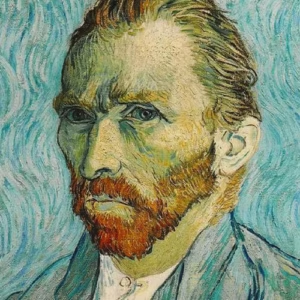
Vincent Willem van Gogh (1853-1890) was a Dutch Post Impressionist painter who is among the most famous and influential figures in the history of Western art.

Another masterpiece Jo. Congratulations. Your photos matching paintings were marvellous too.
Would love to catch up with you.
With love
Trish
Thanks so much Trish. I’m glad you liked the photos too. I was bowled over by the resemblance of the man at the market to the gardener in Vincent’s portrait. And even the postman bore a slight resemblance to M Roulin! XX
I cannot tell you how much I have enjoyed reading this early on a grey early morning in Suffolk and the pleasure with which I recalled the short visit to Arles with you. So much I didn’t know, understand, or appreciate about Van Gogh. Can’t thank you enough.
Hi dear Paula. It’s pretty grey in Sydney too (matching everyone’s mood, I guess) so it lifted my spirits enormously to revisit my memories of Arles and discover more about that magnificent man. Hang in there, spring is coming! XX